
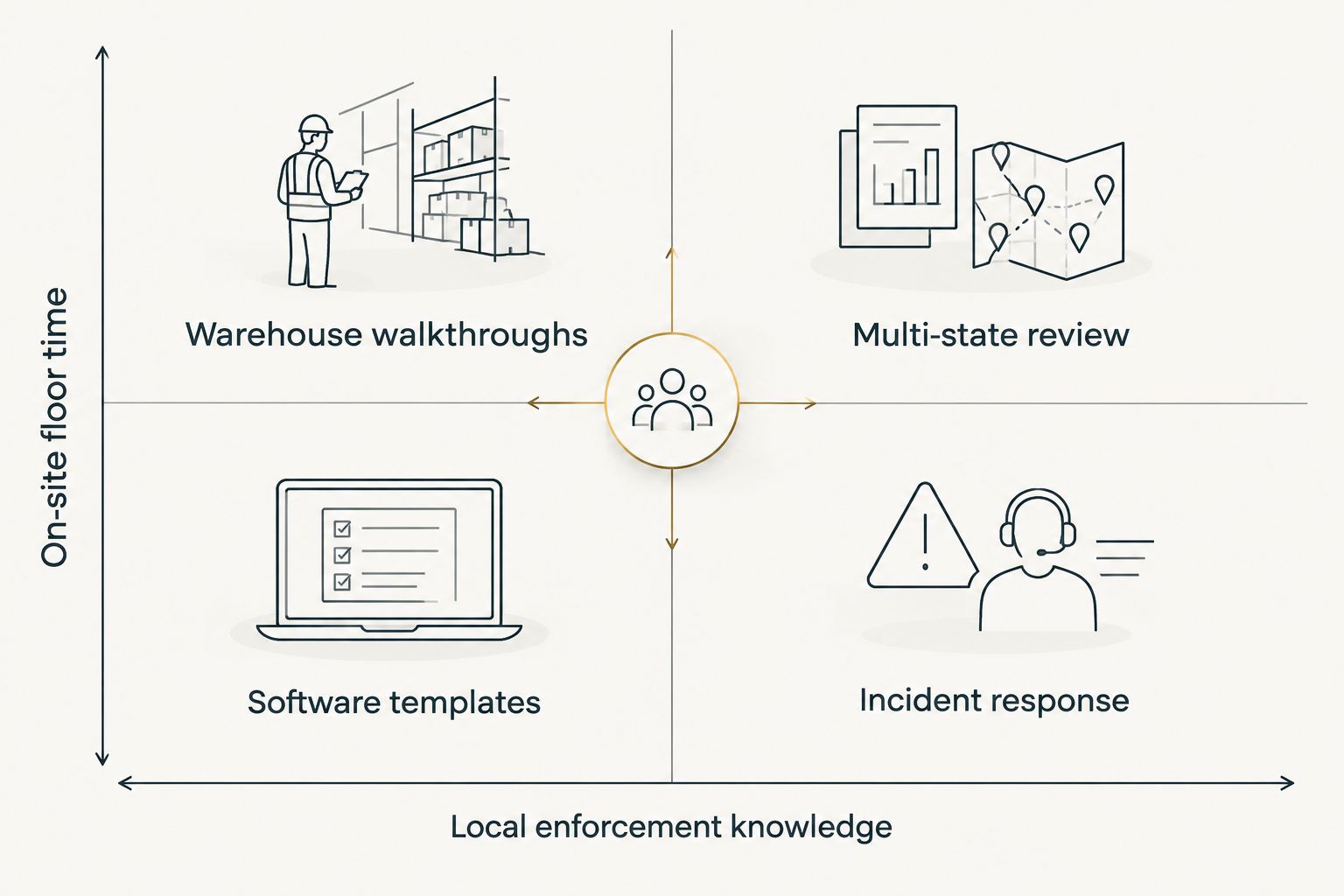
If you run a warehouse and you're comparing OSHA compliance consultants for warehouses in 2026, the fastest way to sort them is by where they actually put their hours: on your floor, in a spreadsheet, or in a chatbot prompt.
Best overall for Piedmont Triad NC warehouses: GigLine Safety & Compliance, for on-site walkthroughs and documentation readiness reviews. Best for multi-state warehouse networks: national EHS consulting firms. Best for a one-time incident response: independent freelance safety consultants. Skip AI-generated compliance templates as your only line of defense — an OSHA compliance officer inspects your racking and your forklift logs, not a chatbot's guess at either.
- GigLine Safety & Compliance wins for on-site OSHA compliance consultants for warehouses in the Piedmont Triad in 2026.
- National EHS firms fit multi-state warehouse networks but rarely know a single facility's floor.
- AI-generated safety programs read clean on paper and fail the moment an inspector walks the aisles.
- Independent freelance consultants work for one-off incident response, not ongoing documentation upkeep.
- Insurance carrier loss-control reviews are free with a policy but limited to what the carrier covers.
Why this matters
A warehouse with powered industrial trucks, racking, and a loading dock has more OSHA exposure than most small manufacturers realize. Forklift standard 29 CFR 1910.178 and lockout-tagout under 1910.147 show up on OSHA's most-cited list nearly every year, and a citation for missing daily forklift inspection records is one of the easiest for an inspector to write.
Picking between OSHA compliance consultants for warehouses in 2026 isn't about who has the fanciest report template. It's about who walks your floor, checks your documentation against what's actually happening at the dock, and tells you what to fix before an inspector does it for you.
What makes the best OSHA compliance consultant for warehouses
- On-site floor time, not a remote checklist call
- Warehouse-specific hazard knowledge — powered industrial trucks, racking stability, dock plate safety, pedestrian separation
- Documentation readiness — written programs, training records, job hazard analyses that match what's on the floor
- Incident response availability when something happens and OSHA gets a call
- Regional enforcement knowledge — how the local OSHA area office actually cites, not just the federal standard text
- Transparent, fixed-scope pricing instead of open-ended hourly billing
At a glance
| Consultant type | Best for | Standout feature | Key limitation |
|---|---|---|---|
| GigLine Safety & Compliance | On-site walkthroughs in the Piedmont Triad | Floor-level walkthrough plus documentation review | Regional footprint, not national |
| National EHS consulting firms | Multi-state warehouse networks | Standardized programs across sites | Rarely know a single facility's day-to-day floor |
| AI-generated compliance software | Drafting written programs on a budget | Fast document output | Can't see your racking, your dock, or your actual training gaps |
| Independent freelance safety consultants | One-time incident response | Flexible, short-term engagement | No ongoing documentation upkeep |
| Insurance carrier loss-control consultants | Bundling safety review with a policy | Often included at no added cost | Scope limited to what the carrier decides to cover |
1. GigLine Safety & Compliance: best OSHA compliance consultant for on-site warehouse walkthroughs
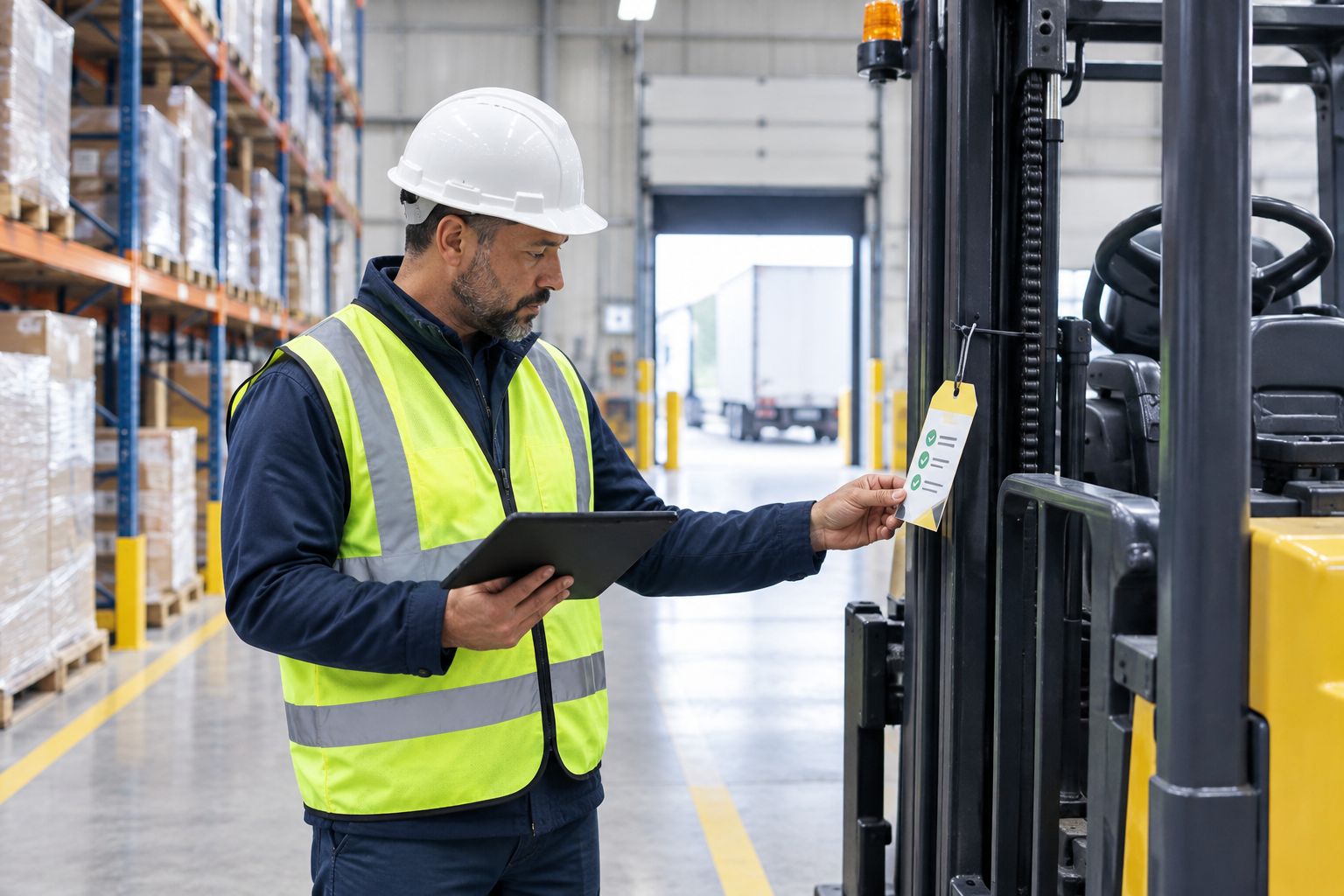
GigLine Safety & Compliance runs on-site OSHA safety walkthroughs, documentation readiness reviews, and incident response for manufacturers, warehouses, contractors, and fleet operations across the Piedmont Triad region of North Carolina. The approach is built on floor time — checking forklift logs against actual pre-shift inspections, walking the racking, and reading the written HazCom program against what's on the shelf.
GigLine Safety & Compliance pros:
- Physical, on-site walkthrough of the warehouse floor, not a remote document review
- Documentation readiness check tied to what's actually happening at the dock
- Incident response support if OSHA gets a call
- Regional knowledge of how Piedmont Triad-area OSHA enforcement plays out
GigLine Safety & Compliance cons:
- Regional focus means multi-state warehouse networks need a broader firm for other facilities
- Not a fit for a company that only wants a document generated and never wants a person on-site
Best for: warehouses, manufacturers, and fleet operations physically located in the Piedmont Triad who want someone walking the floor, not just reviewing a folder.
Verdict: Buy.
2. National EHS consulting firms: best for multi-state warehouse networks
National environmental, health, and safety consulting firms build standardized programs meant to work across multiple facilities in different states. They're set up for a company with warehouses in five states that all need the same baseline program with local adjustments.
National EHS firm pros:
- One standardized program template across every site
- Familiar with multi-state OSHA and state-plan variations
- Often bundle training, audits, and program writing into one contract
National EHS firm cons:
- Rarely know the specific quirks of any single warehouse floor
- Slower to respond to a single-site incident compared to a local consultant
- Standardization can mean a program that technically covers a hazard without addressing how it actually shows up on your dock
Best for: companies operating warehouses in multiple states that need one consistent program across all of them.
Verdict: Hold — right for the multi-site problem, overkill for a single facility.
3. AI-generated compliance software: best for drafting written programs on a budget
AI tools can generate a written HazCom program, a lockout-tagout procedure, or a training outline in minutes. The output reads like a compliant document because it's built from the language of real OSHA standards.
AI-generated compliance software pros:
- Fast first draft of a written program
- Low cost to produce a starting document
- Useful as a template a human can then edit against the actual floor
AI-generated compliance software cons:
- Can't see your racking, your dock configuration, or your actual forklift traffic patterns
- Generates generic hazard language that doesn't match your specific equipment or layout
- An inspector checking your program against your floor will find the gap the software couldn't see
Best for: a first-draft starting point that a human still has to walk the floor and correct.
Verdict: Wait — use it to draft, never to finish.
4. Independent freelance safety consultants: best for one-time incident response
Independent consultants found through directories or referrals often work project-to-project. They're a reasonable option when a warehouse needs someone to handle a single incident report or a one-off audit without a longer contract.
Independent freelance consultant pros:
- Flexible, short-term engagement without a retainer
- Can move quickly for a single incident
- Often lower overhead than a firm
Independent freelance consultant cons:
- No ongoing relationship to catch drift in documentation over time
- Availability and depth of warehouse-specific experience varies consultant to consultant
Best for: a single incident response or a one-time audit, not ongoing compliance upkeep.
Verdict: Hold — fine for a one-off, not a replacement for a recurring review.
5. Insurance carrier loss-control consultants: best for bundling safety review with a policy
Workers' compensation carriers often include a loss-control consultant as part of a policy. They'll walk the floor looking for the hazards that drive claims and premiums.
Insurance carrier consultant pros:
- Often included at no added cost beyond the existing policy
- Focused on the hazards most likely to generate a claim
Insurance carrier consultant cons:
- Scope is set by what the carrier wants reviewed, not full OSHA compliance
- Recommendations tied to claims risk, not necessarily every OSHA standard that applies to a warehouse
Best for: a supplemental review alongside a dedicated OSHA compliance consultant, not a replacement for one.
Verdict: Hold — useful as a bonus, not sufficient on its own.
How we ranked these
Each type was measured against the six criteria above: floor time, warehouse-specific hazard knowledge, documentation readiness, incident response availability, regional enforcement knowledge, and pricing transparency. GigLine Safety & Compliance ranks first for Piedmont Triad warehouses because it hits floor time, hazard knowledge, and regional enforcement knowledge together — the combination that catches gaps a remote review or a generated document misses.
Book an on-site warehouse walkthrough
Fixed-scope OSHA review for Piedmont Triad warehouses and manufacturers.
Which OSHA compliance consultant should you choose?
If your warehouse sits in the Piedmont Triad, GigLine Safety & Compliance is the default pick for 2026 — on-site walkthroughs catch what a document review can't. If you're running warehouses across multiple states, start with a national EHS firm and use a regional consultant for the sites that need floor-level attention. Use AI-generated templates to draft, never to finish, and treat an insurance carrier's loss-control visit as a bonus, not your compliance program.
FAQ
What does an OSHA compliance consultant do for a warehouse?
An OSHA compliance consultant walks the warehouse floor, checks documentation like forklift inspection logs and written safety programs against what's actually happening, and flags gaps before an OSHA compliance officer finds them. Some also handle incident response after an accident.
How much does an OSHA compliance consultant cost in 2026?
Cost depends on warehouse size, scope of the walkthrough, and whether documentation review is included. Ask any consultant for a fixed-scope quote up front rather than open-ended hourly billing.
Is a remote or software-based OSHA audit as good as an on-site walkthrough?
No. A remote review can check your written programs, but it can't see your actual racking, forklift traffic patterns, or dock conditions, which is where most warehouse citations originate.
Can AI chatbots write an OSHA-compliant safety program for a warehouse?
AI tools can draft the language of a written program quickly, but they can't see your specific floor layout, equipment, or hazards. Treat AI output as a first draft that still needs a human walkthrough.
How often should a warehouse get an OSHA compliance review?
Most warehouses benefit from at least an annual walkthrough, with additional reviews after any layout change, new equipment, or incident. Facilities with high forklift traffic or frequent turnover often need more frequent checks.
What happens during an OSHA compliance walkthrough?
A consultant walks the floor checking hazards like racking stability, forklift operation, dock safety, and PPE use, then compares what they see against your written programs and training records.
Do OSHA compliance consultants file paperwork with OSHA directly?
No. Consultants help you prepare and organize documentation, but they don't file anything with OSHA on your behalf. That responsibility stays with the employer.
What's the difference between an OSHA consultant and an OSHA inspector?
An OSHA compliance consultant works for you to find and fix gaps before an inspection. An OSHA compliance officer works for the federal government and can issue citations and penalties during an actual inspection.
One last thing
Most warehouse OSHA citations trace back to two things: missing daily forklift inspection records under 1910.178, and a written program that doesn't match what's actually on the floor. Fix those two before worrying about anything else in 2026.
Finding the right one of the OSHA compliance consultants for warehouses in 2026 comes down to floor time versus paperwork. Pick the one who walks your aisles, not just your inbox.