
Written safety program templates for manufacturers are everywhere in 2026: free from OSHA, sold by safety councils, generated by ChatGPT in ten seconds. None of them tell you whether the paper matches your floor. Here's how the real sources stack up, and which one actually holds up when an inspector walks in.
- OSHA.gov's free model programs are the best zero-cost start for written safety program templates for manufacturers in 2026.
- NC's On-Site Consultation Program gives you a free document review plus an actual person walking your floor.
- AI-generated programs from ChatGPT and similar tools read clean but miss the real hazards on your floor. Use them for a first draft only.
- No template, free or paid, replaces checking the document against what's actually happening on your floor.
Why this matters
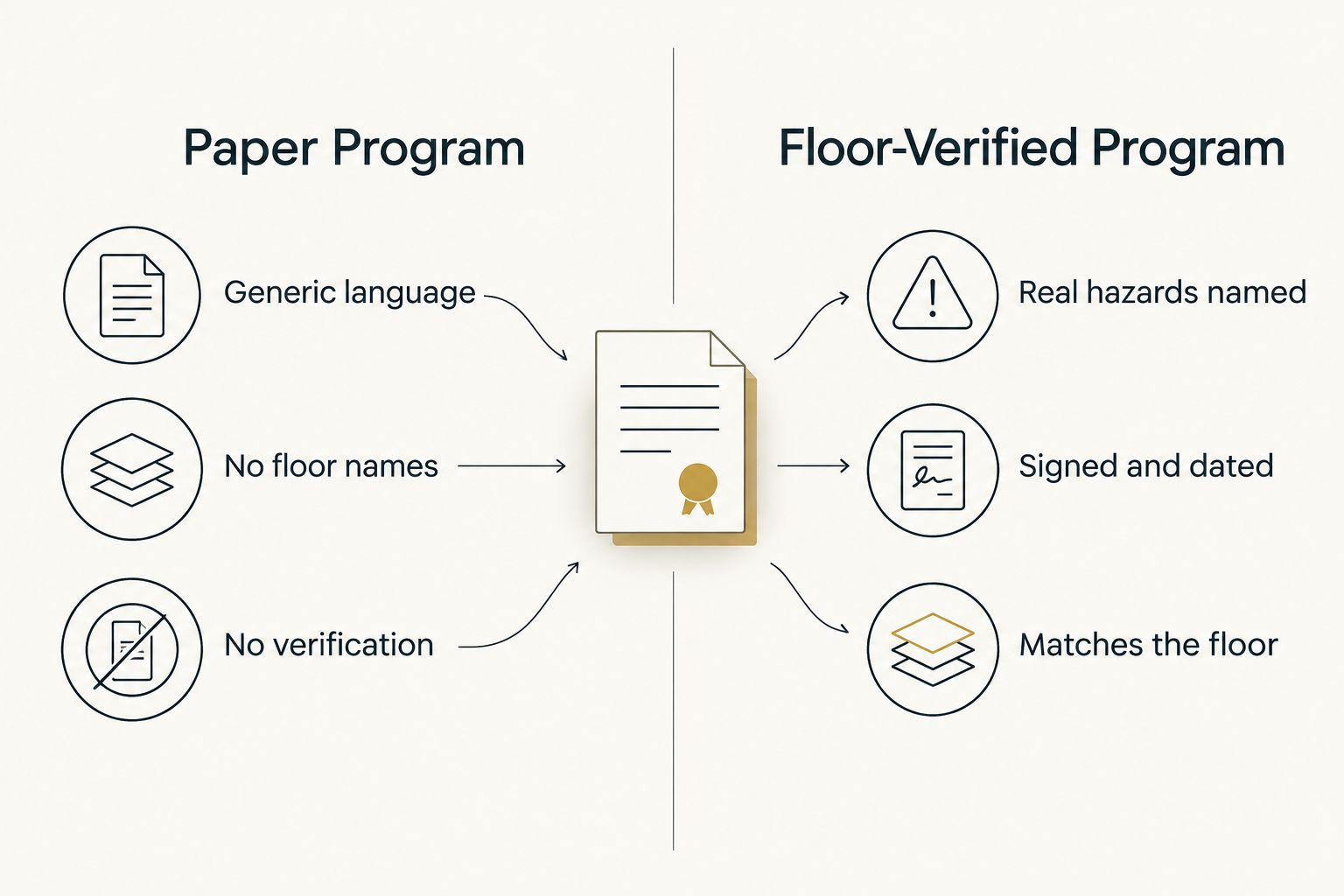
A written program sitting in a binder that doesn't match your floor is worse than having no program at all. An inspector who reads the document, then walks five feet and finds a different lockout point, a missing PPE station, or a hazard that isn't named anywhere in the paperwork, now has two problems to write up instead of one.
I've seen this at plants across the Piedmont Triad more times than I can count before GigLine Safety & Compliance ever got called in. Every source below hands you a document. None of them walk your floor and check whether that document is true. That's a separate step, and it's the one most manufacturers skip because the paperwork feels like the finish line.
What makes a written safety program actually usable
Before you pick a source, know what you're grading it against:
- Covers the standards that actually apply to your floor (HazCom, LOTO, PPE, respiratory, confined space), not a generic list of every OSHA standard that exists
- Names your real equipment, your real job titles, and your real hazards, not placeholders like "Machine A"
- Gets signed, dated, and reviewed on a schedule you can point to
- Matches your training records to the same names on your org chart
- Survives an inspector reading the document, then walking to the spot it describes
- Gets updated when your floor changes, not just when someone remembers to update it
Written safety program templates at a glance (2026)
| Template source | Best for | Standout feature | Key limitation |
|---|---|---|---|
| OSHA.gov Model Written Programs | Free baseline documentation | Pulled straight from the standard text | Generic, no facility-specific detail |
| NC Dept. of Labor On-Site Consultation | Free NC-specific document review | Comes with an actual walk-through | Scheduling can run weeks out |
| National Safety Council Program Library | Coverage of less common standards | Broader library than the free federal samples | Still generic until localized |
| Industry / Trade Association Templates | Sector-specific hazard language | Matches equipment common to your trade | Membership required, coverage varies |
| Cloud EHS Software Platforms | Multi-site version control | Tracks sign-offs and review dates | Runs on whatever template you upload |
| AI-Generated Programs (ChatGPT, etc.) | A fast first draft | Costs nothing, works in seconds | Doesn't know your floor, can miss the standards that apply |
1. OSHA.gov Model Written Programs: best for a free baseline
OSHA publishes free sample and model written programs straight from the standard text, covering Hazard Communication (1910.1200), Lockout/Tagout (1910.147), PPE, and Emergency Action Plans, among others. You can pull them from osha.gov in 2026 the same way you could five years ago. The regulation language behind them doesn't change often.
OSHA.gov pros:
- Free, direct from the agency that enforces the standard
- Language matches the regulation word for word
- Covers the standards most manufacturers actually need
OSHA.gov cons:
- Zero facility-specific detail. No names, no equipment, no floor plan
- Reads generic to an inspector who's seen the same template a hundred times
- No verification step built in
Best for: a manufacturer starting from nothing who needs a document today. Verdict: Buy. Use it as your starting document, not your finished one.
2. NC Department of Labor On-Site Consultation: best for a free review plus a walk-through
North Carolina's Department of Labor runs a free consultation service, funded separately from OSHA's enforcement arm, that reviews your written programs and walks your floor with you. It doesn't issue citations. It's a different office than the one that shows up for an enforcement inspection.
NCDOL pros:
- Free
- Includes a person walking your floor, not just a document review
- North Carolina specific, familiar with the manufacturing base in the Piedmont Triad
NCDOL cons:
- Scheduling can run weeks out depending on demand
- The consultant documents hazards they find, and you're expected to act on that list
- One visit doesn't maintain itself. The program still needs upkeep after they leave
Best for: an NC manufacturer who wants a free second set of eyes before spending on anything else. Verdict: Buy.
3. National Safety Council Program Library: best for less common standards
The National Safety Council publishes a broader library of safety program templates than what OSHA posts for free, covering standards like confined space entry and bloodborne pathogens that come up less often on a typical manufacturing floor.
NSC pros:
- Wider library than the free federal samples
- Professionally maintained and consistently formatted
- Useful when your floor has a hazard the free templates skip
NSC cons:
- Requires a purchase or membership to access
- Still generic until you add your own equipment and hazard detail
- No on-site verification included
Best for: a facility that already has the common programs covered and needs the less common ones. Verdict: Hold.
4. Industry and Trade Association Templates: best for sector-specific hazard language
Trade groups tied to furniture, textiles, and metal fabrication, all common across the Piedmont Triad, sometimes publish member templates written around the hazards typical to that sector.
Trade association pros:
- Hazard language matches equipment types common to your industry
- Sometimes written by people who've worked the floor type you run
Trade association cons:
- Membership required for most of these
- Coverage is inconsistent across associations and states
- Still paper until you check it against your actual floor
Best for: a manufacturer in a niche sector who wants hazard language closer to their equipment than a generic federal template offers. Verdict: Hold.
5. Cloud EHS Software Platforms: best for multi-site version control
Cloud-based safety management software hosts your written programs, tracks employee sign-offs, and flags a document when it's due for review. Useful once you're running more than one facility and need to know every site has the current version.
Cloud EHS pros:
- Version control across multiple sites
- Automatic reminders when a review date passes
- Accessible on a phone or tablet on the floor
Cloud EHS cons:
- The software tracks whatever template you upload. A bad program stays a bad program, just better organized
- Monthly cost adds up fast across several facilities
- Doesn't verify anything against your actual floor conditions
Best for: a multi-site manufacturer that already has solid programs and needs to manage them at scale. Verdict: Hold.
6. AI-Generated Programs (ChatGPT and similar tools): best for a first draft only
Ask ChatGPT for a written HazCom program and it hands you clean, confident-sounding text in seconds. It's the fastest-growing mistake I see walking into plants in 2026.
AI-generated pros:
- Fast, free, decent starting language for a first draft
AI-generated cons:
- Doesn't know your equipment, your lockout points, your PPE inventory, or your building
- Can cite standards that don't apply to your operation, or miss ones that do
- Reads compliant to a person. Means nothing to an inspector standing on your floor
Best for: generating a rough first draft you then correct against your own floor, nothing more. Verdict: Skip as a finished document.
How I ranked these
I graded every source against the six points above: does it name your real hazards, does it get reviewed on schedule, does it survive an inspector walking from the page to the floor. Free sources that come with an actual person checking your floor, like the NC consultation program, rank above sources that only hand you a document. AI tools rank last because they can't see your floor at all.
Get your paperwork checked against your floor
A Compliance Readiness Visit tells you what's real and what's just paper.
Which written safety program template should you use in 2026?
If you're starting from zero, pull OSHA's free model programs today. If you're in North Carolina and want a second set of eyes at no cost, call the state's On-Site Consultation Program before you spend a dollar on anything else. If your floor already has training records and hazard lists that don't match what's on paper, no template fixes that. That's a floor problem, and it needs a floor answer, not a better PDF.
I built GigLine Safety & Compliance's Documentation Readiness Review around exactly this gap: checking whether your existing written programs, whatever the source, actually match what's happening on your floor right now. That's the part no template, free or paid, can do for you.
FAQ
What is a written safety program?
A written safety program is the OSHA-required document describing how your facility manages a specific hazard, like chemical exposure under Hazard Communication or machine lockout under Lockout/Tagout. It has to name your actual equipment and procedures, not just repeat the regulation.
Are free OSHA templates enough for compliance in 2026?
OSHA's free model programs are a solid starting document, but they're generic by design. You still need to add your facility's real equipment, hazards, and job titles, then check the finished document against your actual floor.
Can I use ChatGPT to write my OSHA safety program?
Use it for a rough first draft, not a finished document. AI tools don't know your lockout points, your PPE inventory, or your building, and a program that reads clean on a screen can still fail the moment an inspector walks your floor.
Does the NC On-Site Consultation Program cost anything?
No. It's a free service funded separately from OSHA's enforcement arm, and it includes a consultant walking your floor along with reviewing your documents.
How often should a written safety program get updated?
Update it whenever your equipment, process, or chemical inventory changes, and review it on a set schedule even when nothing has changed, so the review date on the document stays current.
What's the difference between a written program and a floor-verified program?
A written program is the document. A floor-verified program is that same document checked line by line against what's actually happening on your floor, the equipment, the PPE, the lockout points. Most citations happen in that gap.
Is a written safety program legally required for every manufacturer?
Several OSHA standards, including Hazard Communication and Lockout/Tagout, require a written program if the hazard applies to your operation. Whether a specific standard applies depends on your processes, so check the standard against your floor.
What does GigLine's Documentation Readiness Review check that a template alone doesn't?
It checks whether your existing written programs, whatever the source, actually match what's happening on your floor right now, not just whether the paperwork exists.
One last thing
The templates on this list are all written to satisfy a standard in general. None of them know that your third shift changed the lockout points on the stamping line last month, or that the new operator hasn't seen the updated PPE list. That gap is where citations happen, not in the wording of the document itself. Fix the gap before an inspector finds it for you in 2026.