
Warehouses across the Piedmont Triad ask me the same thing every month: where do I find a written safety program template that actually survives an inspection, not just a file review. Here's the straight ranking for 2026, and where each one runs out of road.
- OSHA's sample written programs are the strongest written safety program templates for warehouses starting from scratch in 2026.
- NC Department of Labor's consultation resources fit North Carolina's state OSHA plan better than a generic federal template.
- National Safety Council templates cover broader documentation, but full library access needs NSC membership.
- AI-drafted safety programs read fine on paper and fail the moment an inspector asks a floor-specific question.
- No written safety program template for warehouses replaces a site walk. It gets you a draft, not proof.
Why this matters
A warehouse citation rarely comes from missing paper. It comes from paper that doesn't match the floor. Powered industrial truck rules (1910.178), lockout/tagout (1910.147), hazard communication (1910.1200), and emergency action plans (1910.38) all require a written program, and inspectors in 2026 still ask the same follow-up question every time: does this document match what's happening on your dock right now.
I run GigLine Safety & Compliance walkthroughs across manufacturers, warehouses, and fleet operations in this region, and the pattern repeats. A manager downloads a template, fills in the company name, and files it. The template was never wrong. It just wasn't written for that building.
Best overall for starting from zero: OSHA's free sample written programs. Best for North Carolina's state plan specifics: NC Department of Labor's consultation resources. Best for a broader documentation library: National Safety Council templates. Best for narrow trade hazards: your industry association's boilerplate. Skip AI-drafted programs entirely for anything you plan to hand an inspector.
What makes the best written safety program template for warehouses
- Cites the specific OSHA standard it covers, not vague safety language
- Has a signature line and a review date built in, not just body text
- Leaves room to fill in your actual equipment, chemicals, and shift schedule
- Matches your state plan (North Carolina runs its own OSHA-approved plan through NCDOL)
- Free or low-barrier to obtain, since you're editing one document, not buying a subscription
- Written in language an inspector recognizes, not marketing copy
At a glance
| Template source | Best for | Standout feature | Key limitation |
|---|---|---|---|
| OSHA sample written programs | Starting from zero | Direct language you can cite in a final plan | Not written for your equipment or shift |
| NC Dept. of Labor consultation resources | NC state-plan detail | Free consultation option through NCDOL | Scheduling can take weeks |
| National Safety Council templates | Broader documentation library | Wider range beyond single OSHA standards | Full access needs NSC membership |
| Trade association boilerplate | Narrow trade hazards | Written by people who know your equipment class | Quality varies by association |
| AI-drafted programs (ChatGPT, etc.) | Nothing I'd stake a citation on | Fast first draft | Reads fine, fails floor-specific questions |
1. OSHA sample written programs: best written safety program template for a warehouse starting from zero
OSHA publishes sample written programs for HazCom, LOTO, respiratory protection, and emergency action plans directly on osha.gov. They're free, public, and written in the exact language an inspector already uses when reading your file.
OSHA sample program pros:
- Free, public, no account needed
- Covers the standards cited most in warehouse inspections: 1910.147, 1910.178, 1910.1200
- Written by the same agency that will read your final version
OSHA sample program cons:
- Generic. Doesn't reference your actual chemical inventory or equipment list
- No built-in way to confirm you've covered your specific hazards
Best for: a warehouse writing its first LOTO or HazCom program from a blank page.
Verdict: Buy as your starting draft, not your finished program.
2. NC Department of Labor consultation resources: best for North Carolina state-plan detail
North Carolina operates its own OSHA-approved state plan through NCDOL, and their consultation program offers free on-site help and program resources tailored to state-specific requirements. That matters here, since a federal template can miss a state-plan nuance.
NCDOL resources pros:
- Built around North Carolina's own state plan requirements
- Free consultation option, separate from enforcement
- Written for the exact regulatory environment your business operates in
NCDOL resources cons:
- Consultation scheduling can take weeks depending on demand
- Resources are broader guidance, not a plug-and-play document for every hazard
Best for: a Piedmont Triad manufacturer or warehouse that wants state-specific alignment before an inspection.
Verdict: Buy, worth the wait for the state-specific detail.
3. National Safety Council templates: best for a broader documentation library
NSC maintains a wider template library than any single OSHA standard covers on its own, useful once you're past your first one or two written programs and building out a fuller safety documentation set.
NSC templates pros:
- Covers more ground than single-standard OSHA samples
- Useful for building a fuller documentation library over time
NSC templates cons:
- Full library access typically requires NSC membership
- Still generic until you edit in your own facility details
Best for: a warehouse already past its first written program and building a complete safety library.
Verdict: Hold, only if you already have membership access.
4. Trade association boilerplate: best for narrow trade-specific hazards
Some industry and trade associations publish templates written specifically for their members' equipment classes. When they're good, they cover hazards a general template misses entirely.
Trade association templates pros:
- Written by people who know your specific equipment class
- Can surface hazards a generic template skips
Trade association templates cons:
- Quality varies widely by association
- Not reviewed against your specific facility
Best for: a warehouse in a niche trade with hazards a general template won't catch.
Verdict: Hold, verify it against your own standards before you file it.
5. AI-drafted programs: skip for anything you plan to hand an inspector
I wrote about this exact failure mode in an earlier field note on AI-generated safety programs. A ChatGPT-drafted program reads clean. It cites real standard numbers. It also has no idea what's actually on your floor, and an inspector's first follow-up question exposes that fast.
AI-drafted program pros:
- Fast first draft, zero cost
- Uses correct standard citations most of the time
AI-drafted program cons:
- No knowledge of your actual equipment, chemicals, or layout
- Fails the moment an inspector asks a facility-specific follow-up
Best for: nothing you plan to submit as your actual written program.
Verdict: Skip.
How we ranked
I ranked these against one test: what happens when an inspector opens the binder and asks you to walk them through a line item. Templates that survive that question rank higher. That's the same test I run on every Safety Walkthrough I do for clients across manufacturing, warehousing, and fleet operations in 2026.
Which written safety program template should you choose?
Start with OSHA's own sample programs if you're writing your first LOTO or HazCom program in 2026. Pull in NC Department of Labor consultation resources for state-plan specifics. Build out further with NSC templates once you're past the basics. Skip AI-drafted programs entirely.
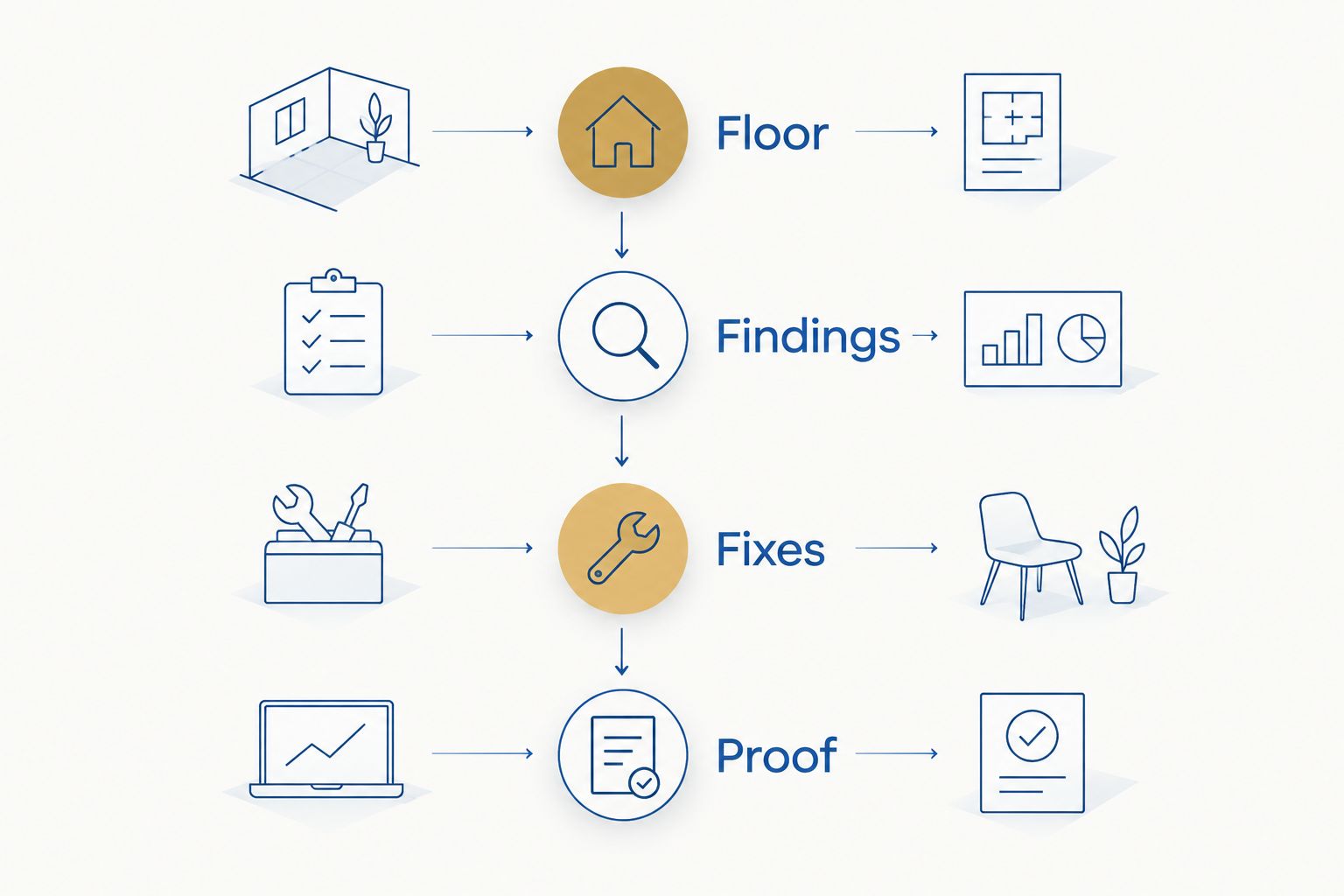
None of these get you to "proof." A written safety program template gets you a draft. My Documentation Readiness Review takes that draft and checks it against what's actually happening on your floor, then my Compliance Readiness Visit walks the site itself to confirm the two match.
Get your written program checked
A Documentation Readiness Review or Compliance Readiness Visit confirms your paper matches your floor.
FAQ
What's the best written safety program template for a warehouse in 2026?
OSHA's own free sample written programs are the strongest starting point in 2026 because they use the exact language an inspector already reads. They still need to be rewritten with your actual equipment and hazards before they're a finished program.
Do OSHA's free sample programs meet the written program requirement on their own?
No. OSHA's sample programs are a structural starting point, not a finished written program. You need to fill in facility-specific equipment, chemicals, and procedures before it satisfies the standard it's written under.
Is a North Carolina warehouse required to follow federal OSHA or the state plan?
North Carolina operates its own OSHA-approved state plan through the NC Department of Labor. Warehouses in the state work under that state plan, which is why NCDOL's own consultation resources fit better than a purely federal template.
Can an AI tool like ChatGPT write my safety programs?
An AI tool can draft language that looks compliant and cites real standard numbers, but it has no knowledge of your actual floor, equipment, or hazards. That gap shows up fast when an inspector asks a facility-specific follow-up question.
How much does OSHA fine a business for a missing written program?
OSHA adjusts its maximum penalty amounts for inflation each year. Check the current figures on osha.gov before assuming a specific number, since they change annually.
Do I need a separate template for every OSHA standard?
Yes. HazCom (1910.1200), lockout/tagout (1910.147), powered industrial trucks (1910.178), and emergency action plans (1910.38) each require their own written program covering that specific hazard.
How often should a written safety program be updated?
Update it whenever your equipment, chemical inventory, or shift structure changes, and review it at minimum any time an OSHA standard it's written under is revised.
Is a written safety program the same thing as what an inspector reviews on-site?
No. The written program is the document. What an inspector reviews on-site is whether the floor matches that document, which is a separate check from having the paperwork filed.
One last thing
I've watched written programs pass on paper and fail on the floor more times than I can count. That gap between the document and the dock is exactly why I built the Documentation Readiness Review the way I did, to catch that mismatch before an inspector does in 2026.
A written safety program template for warehouses is a starting line, not a finish line. Treat it that way and you'll be ahead of most of the buildings I walk through this year.