
You got a call, a letter, or just a rumor that a worker filed an OSHA complaint. You want to know when the inspector actually shows up. Here's the real timeline in 2026, and the deadline that matters more than the one you're asking about.
- OSHA has no fixed legal deadline to inspect after a complaint, but imminent danger reports get a 24-hour response target under its own Field Operations Manual.
- Formal, signed complaints about serious hazards jump the inspection queue ahead of routine programmed inspections in 2026.
- Non-formal or unsigned complaints often get handled by phone or fax, no walkthrough required.
- The deadline that actually bites you is the 6-month statute of limitations on citations under 29 U.S.C. 658(c).
- A Compliance Readiness Visit from GigLine Safety & Compliance gets your documentation in order before that call ever comes.
OSHA has no fixed legal deadline to inspect a workplace after a worker complaint, but its own Field Operations Manual sets an internal target of 24 hours for complaints alleging imminent danger in 2026, and formal complaints about serious hazards typically move to the front of the inspection queue within days to a few weeks depending on how busy the local area office is. The number that should actually worry you is different: OSHA has 6 months from the date of the violation to issue a citation under 29 U.S.C. 658(c), so a delayed inspection doesn't mean you're in the clear, it means the clock is already running before anyone walks through your door.
Why this matters on your floor
I've watched plant managers relax because "it's been three weeks and nobody's shown up." That relief is misplaced. OSHA doesn't have to knock tomorrow. It has to act inside a statute of limitations that started the day the hazard existed, not the day the complaint landed on a compliance officer's desk.
The practical question isn't "when will they show up." It's "what does my floor look like the day they do." A Compliance Readiness Visit tells you that before OSHA does.
How long does OSHA have to inspect after a worker complaint?
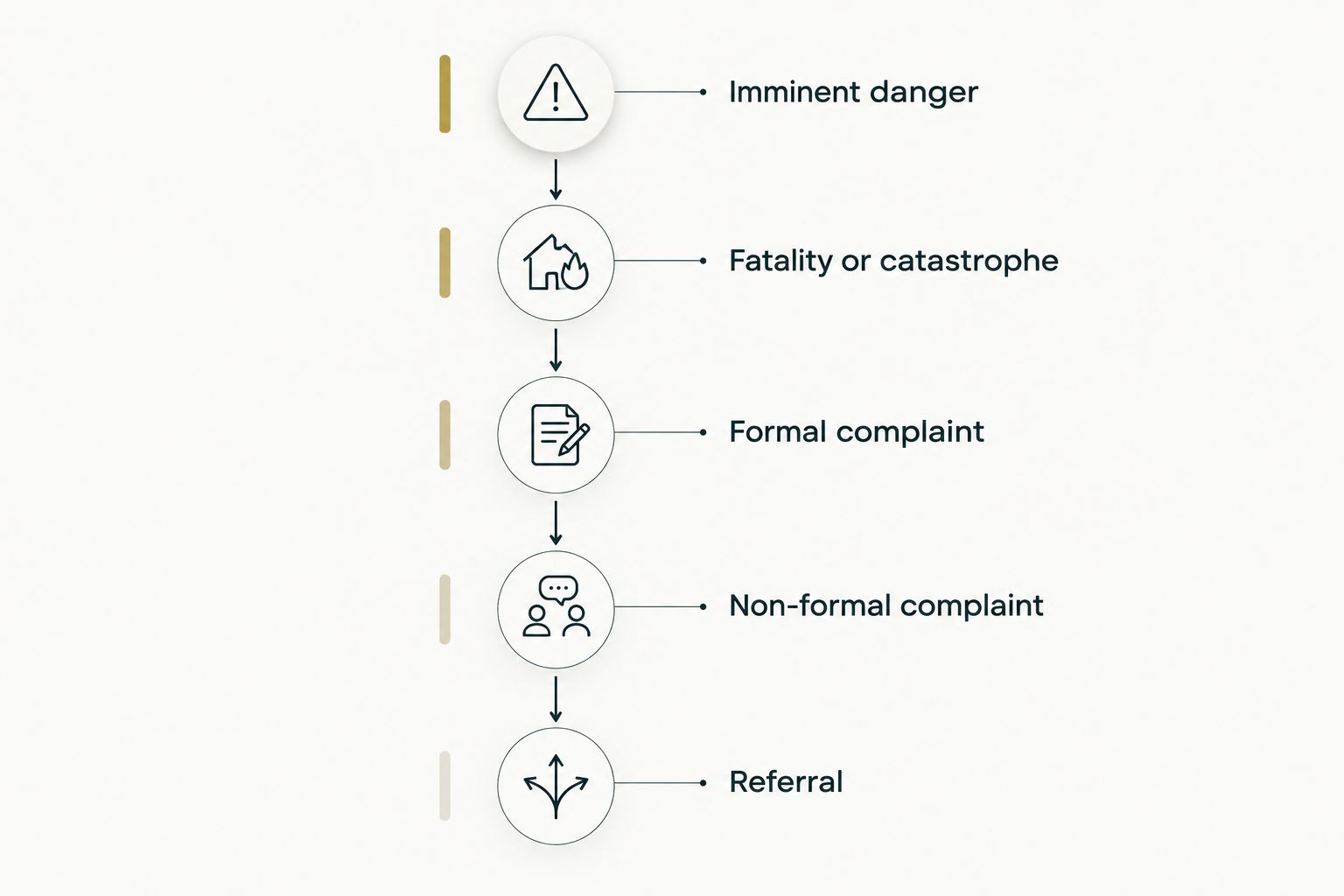
OSHA ranks every complaint against its national inspection priority system. Complaints don't sit in one bucket, they get sorted by how dangerous the alleged hazard is, and that sorting decides the timeline.
| Complaint type | OSHA's internal timeline | Onsite inspection likely? |
|---|---|---|
| Imminent danger | Within 24 hours | Yes, high priority |
| Fatality or catastrophe | Immediate, same-day response expected | Yes, mandatory |
| Formal (signed) complaint, serious hazard | Days to a few weeks | Usually yes |
| Non-formal (unsigned or phone) complaint | Variable, often handled without a visit | Often no, phone/fax investigation instead |
| Referral from another agency | Depends on area office caseload | Case by case |
Imminent danger and fatality complaints outrank scheduled, programmed inspections entirely. If your facility already had a programmed inspection on the calendar and a formal complaint comes in above it, the complaint moves first.
Imminent danger complaints: inspected within 24 hours
When a worker reports something OSHA classifies as an imminent danger, meaning a hazard that could cause death or serious harm before it can be corrected through normal channels, the agency's own manual sets a same-day or next-day response target. That's the fastest category OSHA has, faster than fatalities in terms of paperwork, because the theory is someone could still get hurt if they wait.
This is also the category where I've seen the least warning. No letter first. Sometimes a compliance officer is standing at the guard shack asking for the safety manager.
Formal complaints alleging serious hazards: onsite within days to weeks
A formal complaint is a written, signed complaint from a current employee or their representative. It carries more weight than an anonymous tip because OSHA can follow up directly with the person who filed it, and it moves ahead of routine programmed inspections in the queue.
How fast the onsite visit happens after that depends on the local area office's caseload in 2026, not on a number written into the regulation. Some Piedmont Triad facilities I've walked have gotten a knock inside a week of a formal complaint. Others sat for over a month before a compliance officer called to schedule.
Non-formal complaints: phone or fax, no walkthrough guaranteed
An unsigned complaint, or one called in without much detail, often gets handled through what OSHA calls a phone/fax investigation. The area office sends the employer a letter describing the alleged hazard and requires a written response within a set period, no compliance officer ever sets foot on the property.
That sounds like a pass. It isn't. Your written response becomes part of the record, and if it's vague or defensive, it can trigger the very onsite visit you avoided in the first place.
Why inspection timing varies
- Complaint classification. Imminent danger and fatality complaints jump every other category.
- Area office caseload. A busy regional office in 2026 can mean weeks of delay even on a formal complaint.
- Whether the complaint is signed. Formal complaints get more attention and faster movement than anonymous ones.
- Local or national emphasis programs. If your industry or hazard type is under an active OSHA emphasis program, complaints in that category move faster.
- Facility history. Repeat complaints at the same address, or a prior citation history, tend to shorten the timeline.
- How the complaint is worded. Vague complaints often get routed to phone/fax review first, specific ones with named hazards move to onsite faster.
Does OSHA tell the employer who filed the complaint?
OSHA keeps a complainant's identity confidential if the worker requests it, under Section 8(f)(1) of the OSH Act. That protection is why plant managers rarely find out who called it in, and it's part of why guessing and retaliating is a legal risk on top of a safety one.
What happens if OSHA doesn't show up after a complaint?
No onsite visit doesn't mean the complaint disappeared. A non-formal complaint often gets closed through a phone/fax investigation, where OSHA requires a written response describing what you did about the alleged hazard, and that response becomes part of your compliance file whether an inspector ever visits or not.
How long can OSHA wait to issue a citation after an inspection?
OSHA has 6 months from the date of the alleged violation to issue a citation, under the statute of limitations at 29 U.S.C. 658(c). That deadline runs from when the hazard existed, not from when the complaint was filed or the inspection happened, which is exactly why a delayed inspection doesn't buy you real cover.
“A slow inspector doesn't mean a slow clock. The 6-month statute of limitations started the day the hazard existed.”
Know what OSHA would find before they find it
A Compliance Readiness Visit maps your floor against the standards before the call comes.
FAQ
How long does OSHA have to inspect after a complaint in 2026?
OSHA has no fixed legal deadline, but imminent danger complaints get a 24-hour internal response target, while formal complaints about serious hazards typically move within days to a few weeks depending on the local area office's caseload in 2026.
Does a worker complaint always trigger an onsite OSHA visit?
No. Non-formal or unsigned complaints are often handled through a phone or fax investigation, where you submit a written response instead of hosting a walkthrough.
Can OSHA show up without warning after a complaint?
Yes, especially for imminent danger complaints, where a compliance officer can arrive the same day or next day with no advance letter.
How long can OSHA wait before issuing a citation?
OSHA has 6 months from the date of the violation to issue a citation under 29 U.S.C. 658(c), regardless of when the complaint was filed or the inspection happened.
Will OSHA tell me who complained?
OSHA keeps the complainant's identity confidential on request under Section 8(f)(1) of the OSH Act, so employers rarely learn who filed the complaint.
Does a formal complaint move faster than a scheduled OSHA inspection?
Yes. Formal, signed complaints alleging serious hazards outrank routine programmed inspections in OSHA's priority system, which can push your scheduled visit later while the complaint moves first.
What should I do while waiting to hear if OSHA will inspect?
Document your corrective actions on the alleged hazard immediately, because your written response to any OSHA inquiry becomes part of the compliance record whether or not an inspector visits.
One last thing
The date on the complaint doesn't matter nearly as much as the date on the hazard. OSHA's 6-month statute of limitations runs from when the violation existed, so a company that waits out a quiet three weeks after a complaint hasn't bought safety, it's burned a third of the clock an inspector would have used to build a citation. I'd rather find what they'd find first, on my terms, on your floor.