
The best confined space entry program template for manufacturers is a site-specific written program built around actual spaces and entry tasks. For your 2026 review, use OSHA’s sample permit as a supporting form, not as a substitute for the program.
- A confined space entry program template for manufacturers must connect identified spaces, hazards, entry controls, and rescue arrangements.
- OSHA Appendix D supplies a sample entry permit, not a complete written program.
- Alternate procedures and reclassification require different conditions and documentation; neither is a general shortcut.
- GigLine Safety & Compliance is best suited to Piedmont Triad manufacturers seeking an on-site Compliance Readiness Visit.
Why the floor comes before the form
I would not start by choosing the longest document. Start by identifying the spaces workers enter, why they enter them, and what changes during the job. A tank that looks harmless when empty can present different hazards during cleaning or maintenance.
GigLine Safety & Compliance serves manufacturers in North Carolina’s Piedmont Triad. Request a Compliance Readiness Visit when you need to connect the conditions on your floor with the documents you rely on.
For general-industry manufacturing operations, the central federal reference is OSHA’s permit-required confined spaces standard, 29 CFR 1910.146. Construction work has a separate confined-space standard. Classify the work before choosing the paperwork.
What makes a useful confined space template
For a 2026 program review, I would judge a template against these criteria:
- Space identification: It helps you record which spaces meet the confined-space definition and which are permit-required.
- Task-specific hazards: It distinguishes normal conditions from hazards introduced by cleaning, maintenance, chemicals, or connected equipment.
- Entry controls: It connects isolation, atmospheric testing, ventilation, and acceptable entry conditions to the actual job.
- Assigned duties: It separates entrant, attendant, and entry-supervisor responsibilities.
- Rescue arrangements: It identifies how rescue will work, rather than stopping at a telephone number.
- Usable records: It gives you a way to document authorization, termination, review, and necessary changes.
A confined space has all three defining characteristics: a worker can bodily enter it, entry or exit is limited or restricted, and it is not designed for continuous employee occupancy. A permit-required space also has a qualifying hazard, such as a hazardous atmosphere, engulfment potential, a trapping configuration, or another recognized serious hazard.
A difficult entrance alone does not settle the classification. Neither does the equipment name.
Template approaches at a glance
These are document approaches, not competing software products. The first is the foundation for permit-space entry. The others support particular decisions or tasks.
| Document approach | Best for | Standout feature | Key limitation |
|---|---|---|---|
| Site-specific written permit-space program | Manufacturers authorizing permit-space entry | Connects spaces, duties, controls, and rescue | Requires facility-specific assessment and implementation |
| OSHA Appendix D sample permit | Structuring entry authorization | Lists the information needed for a permit | Does not replace the written program |
| Alternate-procedure documentation | Spaces meeting 1910.146(c)(5) conditions | Records the basis for a ventilation-controlled entry approach | Does not apply when other hazards remain |
| Reclassification certification | Spaces meeting 1910.146(c)(7) conditions | Documents elimination of permit-space hazards | Hazard control alone does not establish eligibility |
1. Site-specific written program: best for permit-space entry
A site-specific written program explains how your facility manages permit-required confined-space entry. It connects the space inventory with entry procedures, equipment, people, contractor coordination, and rescue arrangements. A blank template supplies headings; your assessment supplies the operating facts.
For a 2026 manufacturing program, begin with the entry task. Cleaning a vessel, clearing a blockage, and servicing connected machinery are not interchangeable jobs. The document needs to account for the hazards involved in the work being authorized.
Site-specific program strengths:
- Gives workers and supervisors a common entry process.
- Connects individual permits to facility-wide responsibilities.
- Provides a place for contractor coordination and program review.
Site-specific program limitations:
- Generic language does not establish that a control works on your equipment.
- A completed binder does not demonstrate employee proficiency or rescue capability.
- Procedures become inaccurate when equipment or tasks change without review.
Best for: Manufacturers whose employees enter permit-required confined spaces.
I would check whether a supervisor can use the program to answer practical questions: Who isolates the equipment? Who tests the atmosphere? What ends the entry? Who performs rescue, and what establishes that they can reach the entrant?
My judgment: make the site-specific program the foundation. Do not authorize entry from a template that still contains unanswered operating questions.
2. OSHA Appendix D sample permit: best for entry authorization
OSHA’s Appendix D to 1910.146 provides sample confined-space entry permits. Use the samples to structure authorization for a particular space and task. They help separate permission to enter from the broader rules governing your entry program.
A permit should address the space, purpose, authorized duration, people assigned to the entry, hazards, controls, acceptable conditions, testing, communication, and rescue arrangements. These are operational decisions, not fields to fill from memory after the work starts.
Sample permit strengths:
- Provides an established reference for permit content.
- Makes entry conditions and authorization visible together.
- Supports review of what happened during an entry.
Sample permit limitations:
- Does not identify your facility’s spaces or hazards.
- Does not establish isolation procedures or rescue capability.
- Needs adaptation to the entry being authorized.
Best for: Manufacturers that need an entry-permit form within an established written program.
Under 1910.146(e)(6), retain each canceled entry permit for at least 1 year to support program review. Record problems encountered during entry so the review addresses actual conditions rather than an empty filing requirement.
My judgment: use Appendix D as a permit reference. Do not mistake the sample form for a complete program.
3. Alternate-procedure documentation: best for eligible atmospheric hazards
Alternate procedures under 1910.146(c)(5) apply only when the standard’s conditions are satisfied. The employer must demonstrate that the only hazard posed by the space is an actual or potential hazardous atmosphere and that continuous forced-air ventilation alone is sufficient to maintain safe entry conditions.
Supporting monitoring and inspection data matter. A sentence saying that a fan makes entry safe does not establish eligibility. If initial entry is needed to obtain the supporting data, that entry must follow the applicable permit-space requirements.
Alternate-procedure documentation strengths:
- Makes the eligibility decision explicit.
- Connects ventilation arrangements with supporting atmospheric data.
- Documents the required pre-entry certification.
Alternate-procedure documentation limitations:
- Cannot cover unresolved mechanical, engulfment, or other serious hazards.
- Requires the specified testing and ventilation conditions.
- Does not excuse evacuation when a hazardous atmosphere is detected.
Best for: Spaces that genuinely meet every condition of 1910.146(c)(5).
For your 2026 review, separate this documentation from ordinary permits. The records should show why alternate procedures apply, not simply announce that the facility prefers them.
My judgment: choose this approach only after establishing eligibility. Do not use it to simplify a space whose hazards remain unresolved.
4. Reclassification certification: best for eliminated hazards
Reclassification under 1910.146(c)(7) is a different decision from alternate procedures. The space must have no actual or potential atmospheric hazards, and all hazards within the space must be eliminated without entry. Reclassification lasts only while those hazards remain eliminated.
Where entry is necessary to eliminate hazards, the standard requires permit-space entry procedures for that work. Subsequent reclassification depends on the testing and inspection demonstrating elimination of the hazards.
Reclassification certification strengths:
- Records the basis for treating the space as non-permit.
- Connects the decision to a specific space and assessment.
- Makes hazard elimination distinct from hazard control.
Reclassification certification limitations:
- Ventilation controlling an atmospheric hazard does not establish reclassification.
- Changed conditions can invalidate the basis for the decision.
- Certification cannot substitute for eliminating the hazards.
Best for: Spaces that satisfy the hazard-elimination conditions in 1910.146(c)(7).
The certification must contain the date, location of the space, and signature of the person making the determination. Make it available to employees entering the space or their authorized representatives.
My judgment: document reclassification only when the conditions support it. A different label does not remove a hazard.
Turn the template into an operating system
I use FIND, BUILD, MAINTAIN as the service logic. The practical sequence is Floor, Findings, Fixes, Proof. Your confined-space documents should follow the same sequence instead of starting with a signature page.
Floor
Identify the space and observe the entry task. Include connected equipment, material feeds, energy sources, access restrictions, and work introduced during entry. Ask what happens during abnormal operation, not just normal production.
Findings
Record the classification and the hazards supporting it. Separate observed conditions from assumptions that still require verification. Do not let a generic equipment list stand in for a space-by-space determination.
Fixes
Define the controls and responsibilities required before entry. Connect isolation, atmospheric testing, communication, and rescue arrangements to the task. If the required control is not established, paperwork is not the next step; resolving the condition is.
Proof
Keep the records that demonstrate implementation: permits, applicable certifications, training documentation, and program-review findings. Proof should connect to the space and task. An unsigned checklist or unrelated training certificate does not answer an entry-specific question.
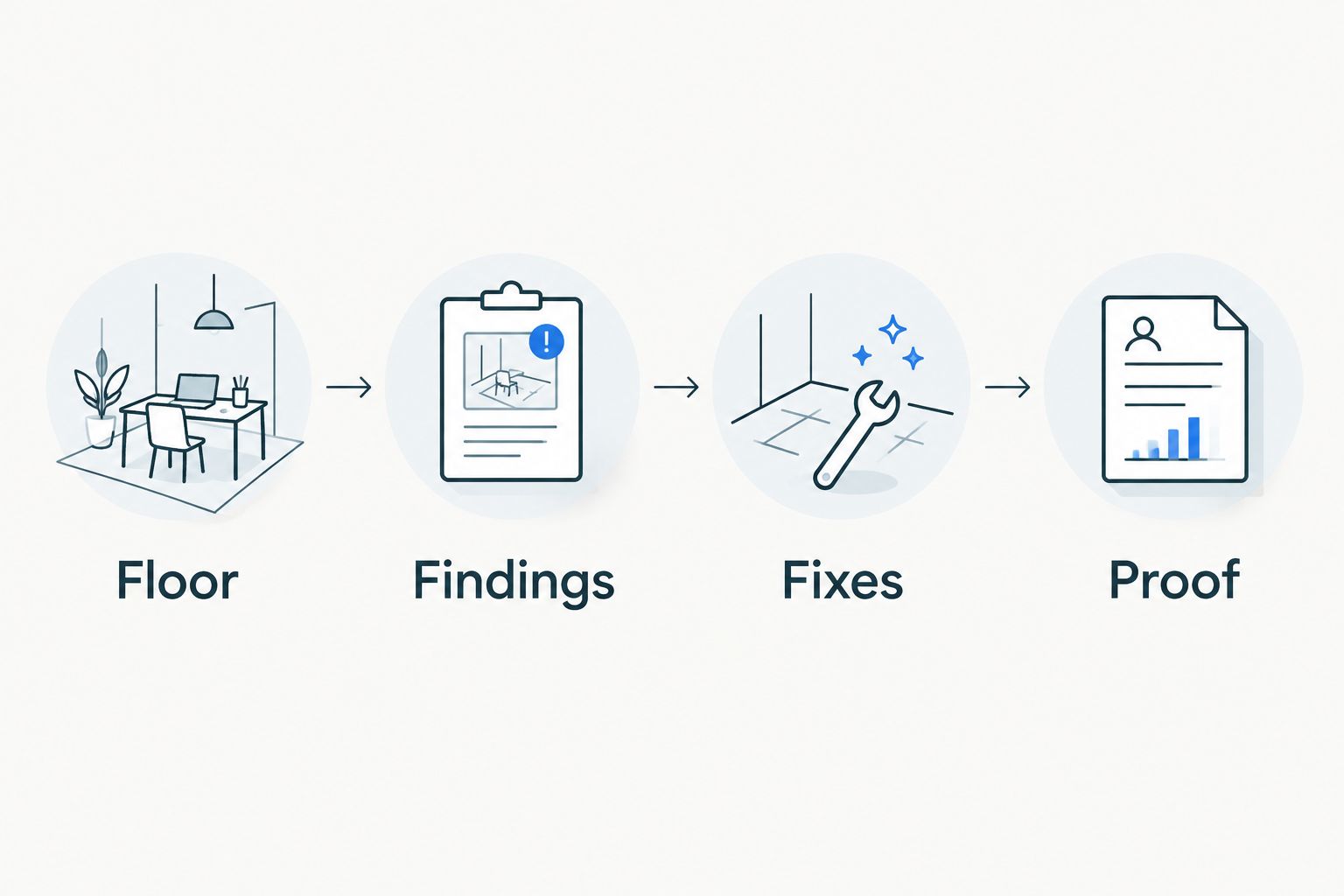
This sequence keeps the document tied to the work. It also gives you a practical review question: can you trace each important finding to a correction and evidence that the correction is in place?
Check these points before authorizing entry
For a 2026 review, I would give these questions priority over formatting:
- Isolation: Does the procedure address every relevant source of energy and material entering the space?
- Atmospheric testing: Does it specify equipment, testing locations, acceptable conditions, and ongoing monitoring appropriate to the hazards?
- Roles: Do the entrant, attendant, and entry supervisor understand their separate duties?
- Rescue: Has the employer evaluated the rescue service’s ability to respond and perform the required rescue?
- Stop conditions: Does everyone know when entry must end and what happens next?
OSHA’s general-industry standard defines oxygen deficiency as below 19.5% oxygen and oxygen enrichment as above 23.5% oxygen. An oxygen reading within those boundaries does not prove that the atmosphere is safe; flammable and toxic hazards still require evaluation.
Under 1910.146(d)(5)(iii), test atmospheric conditions in this order: oxygen, combustible gases and vapors, then toxic gases and vapors. The testing plan must also address the space’s conditions and identified hazards. A single reading at the opening does not establish conditions throughout the space.
A rescue telephone number is not a rescue plan. Under 1910.146(k), the employer must evaluate the service’s response capability and proficiency for the identified permit-space hazards.
How I would choose the document approach
The ranking follows the criteria above: space identification, task-specific hazards, controls, duties, rescue, and records. It ranks document functions, not template sellers. The site-specific program comes first because it connects the whole entry system; the remaining documents serve narrower purposes.
For GigLine Safety & Compliance, the next step is a Compliance Readiness Visit, not a claim that downloading a form makes your facility compliant. The locked service sequence remains FIND, BUILD, MAINTAIN. A service name does not change an employer’s responsibilities under the applicable standard.
Request a Compliance Readiness Visit
Connect your floor conditions with the confined-space documents you rely on.
FAQ
What is the best confined space entry program template for manufacturers?
The best starting point is a site-specific written program based on the facility’s spaces, entry tasks, and hazards. OSHA’s Appendix D sample permit supports entry authorization but does not replace that program.
Can I use OSHA’s sample permit as my entire program?
No. A sample permit records an individual entry authorization; the written program must address the broader procedures, responsibilities, equipment, training, and rescue arrangements required for permit-space entry.
Does every tank require a confined-space entry permit?
No. The employer must evaluate whether the tank meets the confined-space definition and whether it has a permit-space hazard. Equipment names alone do not establish classification.
Can forced-air ventilation replace a permit-space program?
Only qualifying entries can use alternate procedures under 1910.146(c)(5). The employer must demonstrate that the only hazard is atmospheric and that continuous forced-air ventilation alone maintains safe entry conditions, along with meeting the other specified requirements.
Is reclassification the same as using alternate procedures?
No. Reclassification under 1910.146(c)(7) depends on eliminating hazards and having no actual or potential atmospheric hazards. Alternate procedures under 1910.146(c)(5) address qualifying spaces with an atmospheric hazard controlled by ventilation.
How long must canceled confined-space permits be kept?
OSHA’s general-industry standard requires canceled entry permits to be retained for at least 1 year. Use them to review the program and document problems encountered during entry.
What should I request if my documents do not match my floor?
Request a Compliance Readiness Visit from GigLine Safety & Compliance if your manufacturing operation is in the Piedmont Triad. Start with the spaces, tasks, and existing documents rather than assuming a replacement template will solve the problem.
One last thing
OSHA treats entry as having occurred as soon as any part of the entrant’s body breaks the plane of an opening into the space. You do not have to climb completely inside for entry to begin.
For your 2026 review, check the jobs workers describe as just reaching in. Build the entry decision around what the worker actually does, not what the job is called.