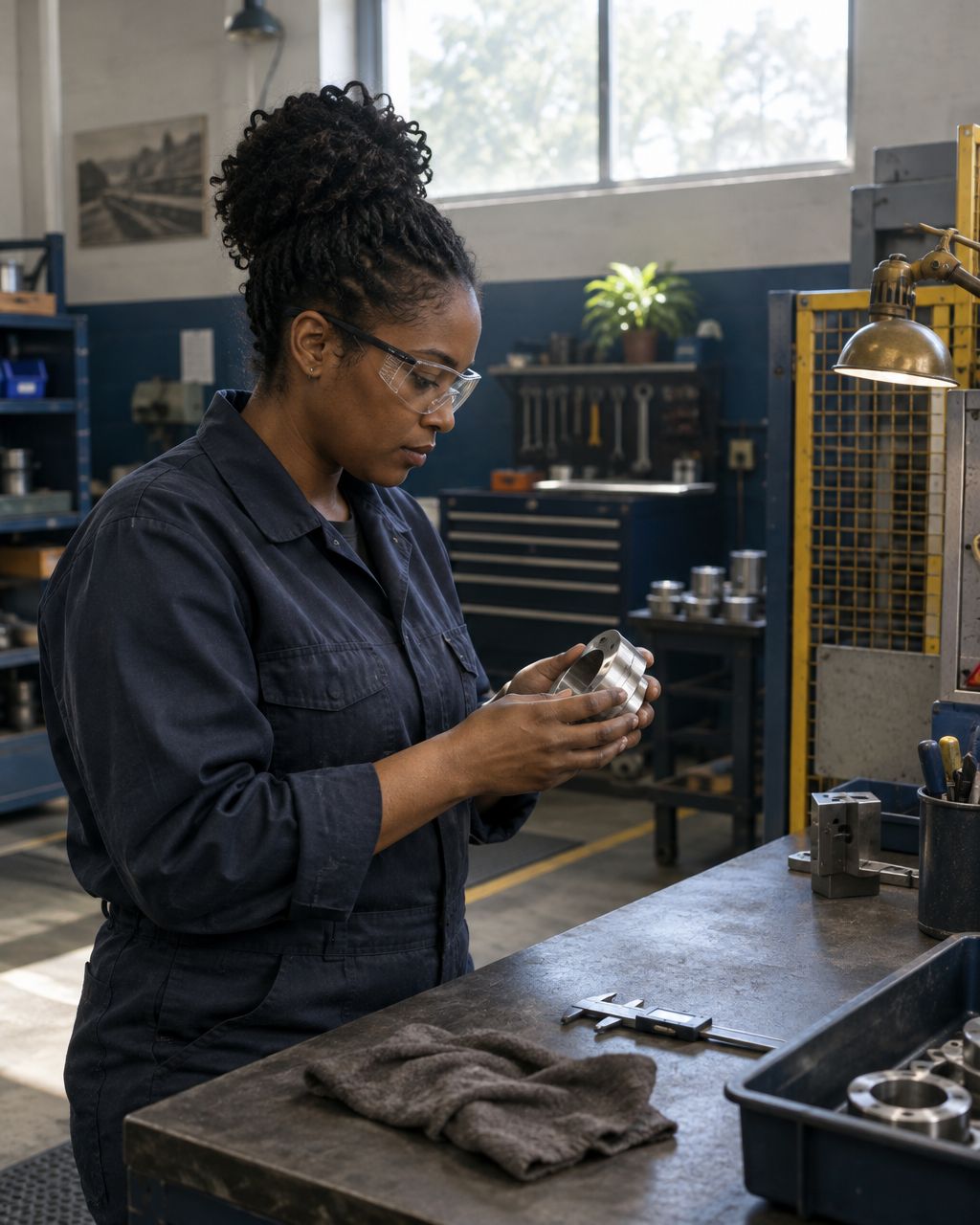
Match machine-shop eye protection to the task. Use marked safety glasses with side protection for flying chips, splash-rated goggles where coolant can reach the eyes, primary eyewear under a face shield for grinding that exposes the face, and a task-matched welding helmet over primary eyewear for arc welding. Check the hazard at each station before assigning PPE.
- Flying chips: use marked safety glasses with side protection when the hazard assessment calls for them.
- Coolant splash: choose splash-rated goggles; ordinary glasses leave openings around the eyes.
- Grinding: wear suitable primary eyewear under a face shield when the face is exposed.
- Arc welding: match the helmet shade to the process and current; keep primary eyewear underneath.
Why this matters
A lathe throws chips, a grinder sends fragments toward the face, and coolant handling can splash liquid into the eyes. One box of glasses does not settle all three. Look at the work, including setup and cleanup, before deciding what the employee wears.
OSHA's 29 CFR 1910.133(a)(1) requires appropriate eye or face protection for hazards including flying particles, liquid chemicals, and injurious light radiation. Section 1910.132(d) requires a workplace hazard assessment, suitable PPE selection, communication of that selection to affected employees, proper fit, and written certification of the assessment. GigLine Safety & Compliance checks the floor and the records with Piedmont Triad manufacturers.
Check the hazard, marking, coverage, and fit
Read the marking, then watch the job. A marking alone does not tell you whether the coverage matches the exposure.
- Hazard match: Identify flying chips, airborne dust, liquid splash, or welding radiation at the point of work. Separate routine operation from cleaning, setup, and maintenance.
- Impact marking: Check the product and component markings against the protection required. ANSI/ISEA Z87.1 uses Z87+ to identify high-impact-rated protection; do not assume every item marked Z87 offers that rating.
- Coverage: Side shields address side entry from flying particles. Goggles cover more of the area around the eyes. A face shield extends protection across the face but does not replace primary eye protection.
- Splash designation: If liquid splash is the hazard, check that the goggles carry the applicable splash designation, such as D3 under ANSI/ISEA Z87.1. A close-looking fit is not a substitute for the marking.
- Fit with other equipment: Test protection with prescription eyewear, hearing protection, respirators, and head protection actually used at the station. Gaps and interference change the result.
- Condition and use: Inspect scratched lenses, loose shields, damaged straps, and missing markings. Protection left on a bench does nothing for the operator.
The current ANSI edition is not automatically the OSHA rule
ANSI/ISEA Z87.1-2025 has been published. OSHA's general-industry rule at 29 CFR 1910.133(b)(1), however, currently incorporates ANSI/ISEA Z87.1-2010, ANSI Z87.1-2003, and ANSI Z87.1-1989 (R-1998). Under §1910.133(b)(2), an employer may also demonstrate that another device is at least as effective as protection made to one of those incorporated editions. A 2025 marking alone is not proof that OSHA has incorporated the 2025 edition. Match the device and all its markings to the hazard, and keep the basis for your selection. Sources: OSHA §1910.133(b); ISEA's January 8, 2026 announcement of ANSI/ISEA Z87.1-2025.
Eye and face protection by task
| Task and hazard | Eye and face protection to assess | Check before use |
|---|---|---|
| Routine machining: flying chips | Marked safety glasses with side protection | Impact rating, side coverage, fit |
| Coolant handling: liquid splash | Splash-rated goggles | Splash marking, seal and fit; assess impact separately |
| Grinding: flying fragments toward face | Suitable primary eyewear beneath an impact-rated face shield | Markings on both pieces; keep machine guards in place |
| Arc welding: injurious light | Primary eyewear beneath a welding helmet | Filter shade for the process and current; fit under helmet |
This is a task map, not a substitute for the hazard assessment. A station may need more than one form of protection.
1. Safety glasses with side shields: best for routine machining
Safety glasses with side shields are the practical starting point for routine machine work involving flying particles. They cover the eyes while the shields address particles entering from the sides. OSHA specifically calls for side protection when flying objects are a hazard under 29 CFR 1910.133(a)(2).
Safety glasses with side shields pros:
- Easy to assign to routine chip-producing work.
- Side shields address a direction of exposure that front-only lenses leave open.
- Styles can accommodate prescription needs when selected and fitted appropriately.
Safety glasses with side shields cons:
- Openings around the lenses make them the wrong default for liquid splash.
- Side shields do not turn glasses into face protection for grinding.
- Poor fit or damaged shields can leave the wearer exposed.
Best for: Routine machining where the hazard assessment identifies flying particles, not liquid splash or welding radiation. Check the complete eyewear marking and confirm the side protection stays in place during the task. If an employee wears prescription lenses, OSHA requires protection that incorporates the prescription or fits over the lenses without disturbing either pair's position under 29 CFR 1910.133(a)(3).
On the floor: Watch whether the side protection stays in place as the operator looks down or reaches around the machine.
2. Splash-rated goggles: best for coolant splash
Splash-rated goggles cover the space around the eyes more closely than ordinary safety glasses. That distinction matters when a task sends liquid toward the operator, including coolant handling and cleanup. For a liquid-splash hazard, check the product's applicable ANSI/ISEA Z87.1 splash designation rather than choosing by shape alone.
Splash-rated goggles pros:
- Provide eye coverage suited to an assessed liquid-splash exposure.
- Address gaps around the eyes that safety glasses leave open.
- Make the difference between chip protection and splash protection clear in a task-specific PPE list.
Splash-rated goggles cons:
- Do not cover exposed skin across the whole face.
- Straps, prescription glasses, and respirators can interfere with fit.
- A splash designation does not, by itself, settle an impact hazard.
Best for: Machine-shop tasks where liquid can reach the eyes. Check every relevant designation if the same task also exposes the wearer to flying particles. Test the goggles during the actual movement of the job, including looking down into a machine or container.
Do not label an entire coolant area as one task. Filling, directing a hose, and cleaning up put the operator in different positions. Record each exposure and check that the selected goggles stay in place through the work.
3. Primary eyewear plus face shield: best for grinding
Grinding can put flying material on a path toward both the eyes and the face. An impact-rated face shield extends coverage across the front of the face. Wear impact-rated safety glasses or goggles beneath it; the shield is added protection, not a replacement for primary eye protection.
Primary eyewear plus face shield pros:
- Combines primary eye protection with wider front-of-face coverage.
- Makes the face hazard visible in the PPE assignment instead of treating it as an eye-only task.
- Allows the underlying eyewear to remain in place when the shield is raised.
Primary eyewear plus face shield cons:
- The shield leaves exposure if worn without suitable eyewear underneath.
- Fit can change when combined with hearing or head protection.
- Neither item replaces a machine guard or a safe work setup.
Best for: Grinding and other assessed tasks with flying material that can strike the face. Check the markings on both the primary eyewear and the shield. Then watch the job: if the operator repeatedly lifts the shield to see the work, the selected combination needs attention.
Do not use a face shield to excuse a missing guard. OSHA's machine-guarding requirements under 29 CFR 1910.212 address hazards from points of operation, rotating parts, and flying chips and sparks. PPE and guarding solve different parts of the problem.
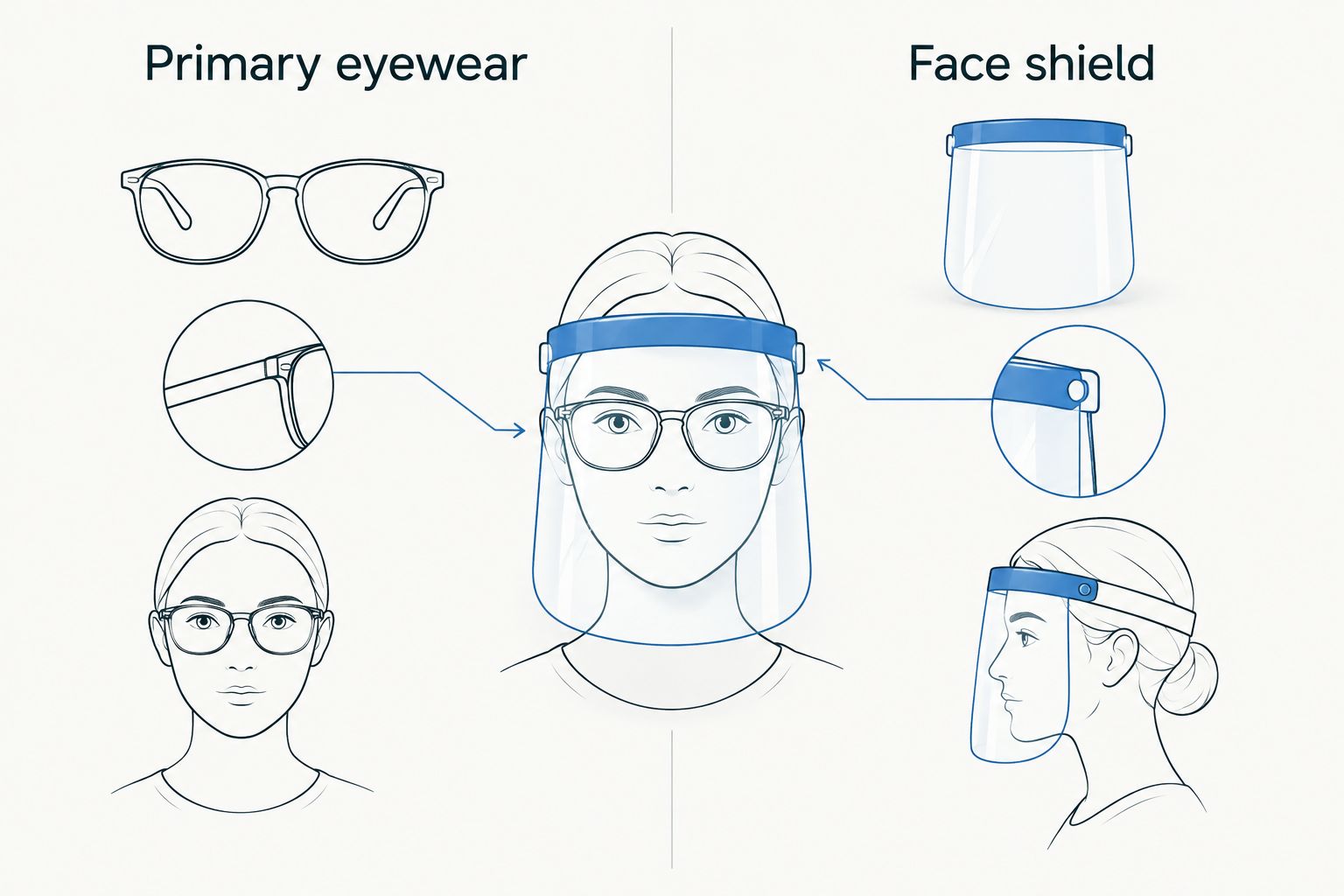
On the floor: If an operator lifts the shield to see the work, address visibility and fit rather than accepting unprotected grinding.
4. Welding helmet plus primary eye protection: best for arc welding
An arc-welding helmet addresses harmful light radiation and front-of-face exposure during welding. Its filter lens must match the process and current. Primary safety glasses or goggles remain underneath so eye protection is present when the helmet is raised.
Welding helmet plus primary eye protection pros:
- Provides a filter lens selected for the welding operation.
- Covers the front of the face while the helmet is down.
- Keeps primary eye protection in the setup for work between welds.
Welding helmet plus primary eye protection cons:
- A helmet chosen without checking the filter shade can be wrong for the operation.
- A raised helmet does not cover the face.
- Helmet fit must be checked alongside any other PPE the welder uses.
Best for: Arc welding, with the filter shade selected from the applicable OSHA table for the specific process and current. OSHA Table 1910.133(a)(5) lists shade 8 as the minimum for shielded metal arc welding at 60–160 amperes. That example is not a universal welding shade; other processes and currents require their own check.
Write the welding process and current into the PPE decision. The word welding alone does not identify a filter shade. Confirm the lens marking and the fit of the eyewear beneath the helmet.
Floor, Findings, Fixes, Proof
- Floor: Observe machining, grinding, coolant handling, and welding, including setup, cleaning, and the moments protection comes off.
- Findings: Record the exposure, existing protection, markings, fit, and gaps. Keep the written certification of the hazard assessment required by §1910.132(d)(2).
- Fixes: Select PPE for each affected employee, address missing guards separately, and communicate the selected PPE to the people who do the work. Under §1910.132(f), train them when it is needed, how to put it on, its limits, care, and removal. Have employees show they can use it before the task; retrain when the equipment or work changes or their use shows a gap.
- Proof: Keep the assessment certification and training certification required by §1910.132(f)(4). Check the actual work against the selection on the next floor walk.
If your PPE list says one thing and your shop floor shows another, request a Compliance Readiness Visit. GigLine can review the floor and the records together.
FAQ
What is the best eye and face protection PPE for machine shops?
There is no single best set for every machine-shop task. Use safety glasses with side shields for assessed routine flying-particle exposure, splash-rated goggles for liquid splash, and primary eyewear beneath a face shield for grinding.
Are safety glasses enough for grinding?
Safety glasses alone do not cover the face. When the grinding hazard assessment calls for face protection, wear suitable primary eye protection under an impact-rated face shield.
Can a face shield replace safety glasses?
No. A face shield is additional face protection, not a substitute for primary eye protection worn underneath.
What should I use around machine coolant?
Use splash-rated goggles when the task exposes the eyes to liquid splash. Check the applicable marking and fit; ordinary safety glasses leave openings around the eyes.
What does Z87+ mean on safety eyewear?
Z87+ identifies high-impact-rated protection under ANSI/ISEA Z87.1. Check the complete markings and the task hazard rather than treating the symbol as protection against every exposure.
Do welders need safety glasses under a welding helmet?
Wear appropriate primary eye protection beneath the welding helmet. Select the helmet filter shade for the specific welding process and current using the applicable OSHA table.
Does OSHA require a machine-shop PPE hazard assessment?
Yes. OSHA's 29 CFR 1910.132(d) requires employers to assess workplace hazards, select suitable PPE, and document the assessment as specified in that provision.