
For fleet operations in 2026, the best OSHA and DOT compliance program is not one document or one vendor. Use GigLine Safety & Compliance for an on-site look at workplace safety, FMCSA requirements for the DOT side, and a named person inside your operation to close and document each finding. GigLine Safety & Compliance is best for Piedmont Triad fleet operations that need their OSHA-side gaps identified on the floor; it is not a substitute for DOT program ownership.
- The best OSHA and DOT compliance programs for fleet operations separate workplace hazards from motor carrier requirements.
- GigLine Safety & Compliance is the on-site OSHA choice for Piedmont Triad fleets, not a DOT program provider.
- Use FMCSA rules to define applicable driver and vehicle records; assign an internal owner to keep proof current.
- Start with a Compliance Readiness Visit, then track each finding through a fix and a dated record.
Why this matters
A fleet has more than one kind of workplace. The shop has equipment, chemicals and people on foot. The yard has vehicle movement and maintenance work. Drivers and vehicles can also fall under federal motor carrier rules. A single binder does not tell you whether a guard is missing, a driver file is incomplete or an inspection record is overdue.
OSHA and DOT answer different questions. OSHA workplace requirements address hazards to workers. Federal Motor Carrier Safety Administration rules address covered motor carriers, drivers and vehicles. The same operation can need both, but a finding under one set of rules does not automatically prove a violation under the other. In 2026, start by deciding which rules apply to your actual work and vehicles. Then check the floor and the records separately.
What makes the best fleet compliance setup
I would judge any 2026 setup against these checks before committing to it:
- Clear scope: It identifies where OSHA workplace rules end and applicable DOT motor carrier rules begin. It does not treat every company vehicle as a regulated commercial motor vehicle.
- Floor check: Someone looks at the shop, yard and work practices instead of relying on written policies alone.
- Record check: The owner can locate the records required for the operation, identify missing proof and assign a fix.
- Named ownership: One person is accountable for each finding. A shared folder is storage, not ownership.
- Repeatable follow-up: The operation checks whether fixes remain in place as vehicles, drivers and work change.
These are separate jobs. You can combine them into one management routine without pretending one provider performs all of them. For a Piedmont Triad fleet, that distinction matters when choosing what to handle internally and what to ask someone else to inspect.
At a glance: which option handles which job?
| Option | Best for | Standout feature | Key limitation |
|---|---|---|---|
| GigLine Safety & Compliance | On-site OSHA-side review in the Piedmont Triad | Looks at workplace conditions alongside documentation readiness | Does not replace a DOT program owner or establish which motor carrier rules apply |
| FMCSA regulations and guidance | Defining applicable federal motor carrier duties | Primary source for driver, vehicle and carrier requirements | Rules do not inspect your shop or close your findings |
| Named internal compliance owner | Keeping OSHA and DOT actions from getting lost | Can assign, verify and retain proof for each fix | Needs time, authority and the right outside help for unfamiliar requirements |
The order is deliberate: find workplace issues, establish the applicable DOT requirements, then keep both sets of fixes alive. If you already have an owner, you still need to test whether that person can show what was checked, what was fixed and where the proof sits.
1. GigLine Safety & Compliance: best for an on-site OSHA check
A fleet's workplace hazards do not sit neatly inside a policy. Powered industrial trucks, chemicals, maintenance equipment and people moving through the yard each need a look at the work itself. GigLine Safety & Compliance serves fleet operations in the Piedmont Triad with on-site OSHA safety walkthroughs and documentation readiness reviews. A Compliance Readiness Visit is the starting point when you need to identify what the floor and the paperwork actually show.
GigLine Safety & Compliance strengths:
- On-site work gives you a way to compare written procedures with visible conditions.
- A documentation readiness review keeps records in the same conversation as floor findings.
- Corrective Action Implementation and ongoing maintenance are listed services when findings call for more than an initial visit.
GigLine Safety & Compliance limits:
- The stated services focus on OSHA safety and readiness, not administration of a DOT compliance program.
- A walkthrough cannot replace the operation's day-to-day responsibility to correct hazards and retain proof.
- Regional service is aimed at the Piedmont Triad, not every fleet location.
Best for: A shop owner, plant manager or fleet operator in the Piedmont Triad who needs a grounded OSHA-side starting point. Verdict: choose a Compliance Readiness Visit for the workplace check; keep DOT ownership separate.
I would begin with the floor, write down the finding, name the fix and keep the proof. That is more useful than filing a polished policy that nobody follows. It also makes the next review specific: you are checking whether an action happened, not merely whether a document exists.
2. FMCSA regulations and guidance: best for defining DOT duties
The FMCSA rules are the place to determine federal motor carrier requirements. First establish whether the vehicle, driver and operation are covered; then identify the records and practices that follow. Do not copy a generic fleet checklist and assume every line applies. Interstate and intrastate work, vehicle characteristics and the type of transportation all matter to the scope decision.
For example, 49 CFR 396.17 addresses periodic inspection of covered commercial motor vehicles at least once every 12 months. That is a vehicle requirement. It does not tell you whether a worker in the shop has been trained to operate a powered industrial truck or whether a chemical container is properly labeled. OSHA's powered industrial truck rule, 29 CFR 1910.178, addresses that separate workplace subject; its operator performance evaluation requirement is at least once every 3 years under 29 CFR 1910.178(l)(4)(iii).
FMCSA regulations and guidance strengths:
- The source defines the federal motor carrier duties rather than relying on a vendor's checklist.
- Rule citations make it possible to trace each requirement to its source.
- You can distinguish driver, vehicle and carrier records before assigning an owner.
FMCSA regulations and guidance limits:
- The rules do not tell you what is happening in your shop or yard today.
- A citation does not organize your files, chase an overdue action or confirm that a fix stayed fixed.
- You must determine applicability; reading a rule heading is not enough.
Best for: The person establishing the DOT side of a fleet program. Verdict: use FMCSA requirements as the source for applicable DOT duties, not as a replacement for an on-site safety check. When the scope is unclear, get qualified help on applicability before building a record system around the wrong assumptions.
3. Named internal compliance owner: best for keeping fixes closed
A consultant visit ends. A rule page stays online. Neither follows up on a repair order unless someone inside the operation owns it. Put a name beside each finding, a required action, a due date you set internally and the proof you expect to see. Then check that the record matches the condition on the floor or the vehicle.
This owner does not need to do every repair or interpret every rule alone. The job is to make sure each issue reaches the right person and returns with evidence. For an OSHA-side finding, that evidence might be an updated procedure plus a check of the work area. For a DOT-side record issue, it might be the completed record and a check that the filing routine now catches the next one. What counts as sufficient proof depends on the requirement and the finding.
Internal owner strengths:
- One person can track both OSHA and DOT actions without mixing up their legal requirements.
- Follow-up can happen as work changes, not only before an outside visit.
- The person who can reach supervisors and records can see when a fix stalls.
Internal owner limits:
- A name on a spreadsheet does nothing without time and authority to follow up.
- Internal review can miss hazards that everyone has learned to work around.
- Unfamiliar DOT applicability questions still need the right expertise.
Best for: A fleet ready to turn findings into assigned work and retained proof. Verdict: choose an internal owner for continuity, and give that person a clear route to outside help. Do not make ownership depend on one person's memory. Keep the finding, action and verification where the next responsible person can find them.
Put the three parts to work
In 2026, I would set up the work in this order: Floor, Findings, Fixes, Proof. Walk the work area first. Record the specific condition and the rule or procedure you need to check. Assign the correction. Keep evidence that someone verified the result. For the DOT side, start with scope and applicable requirements before you create a list of missing records.
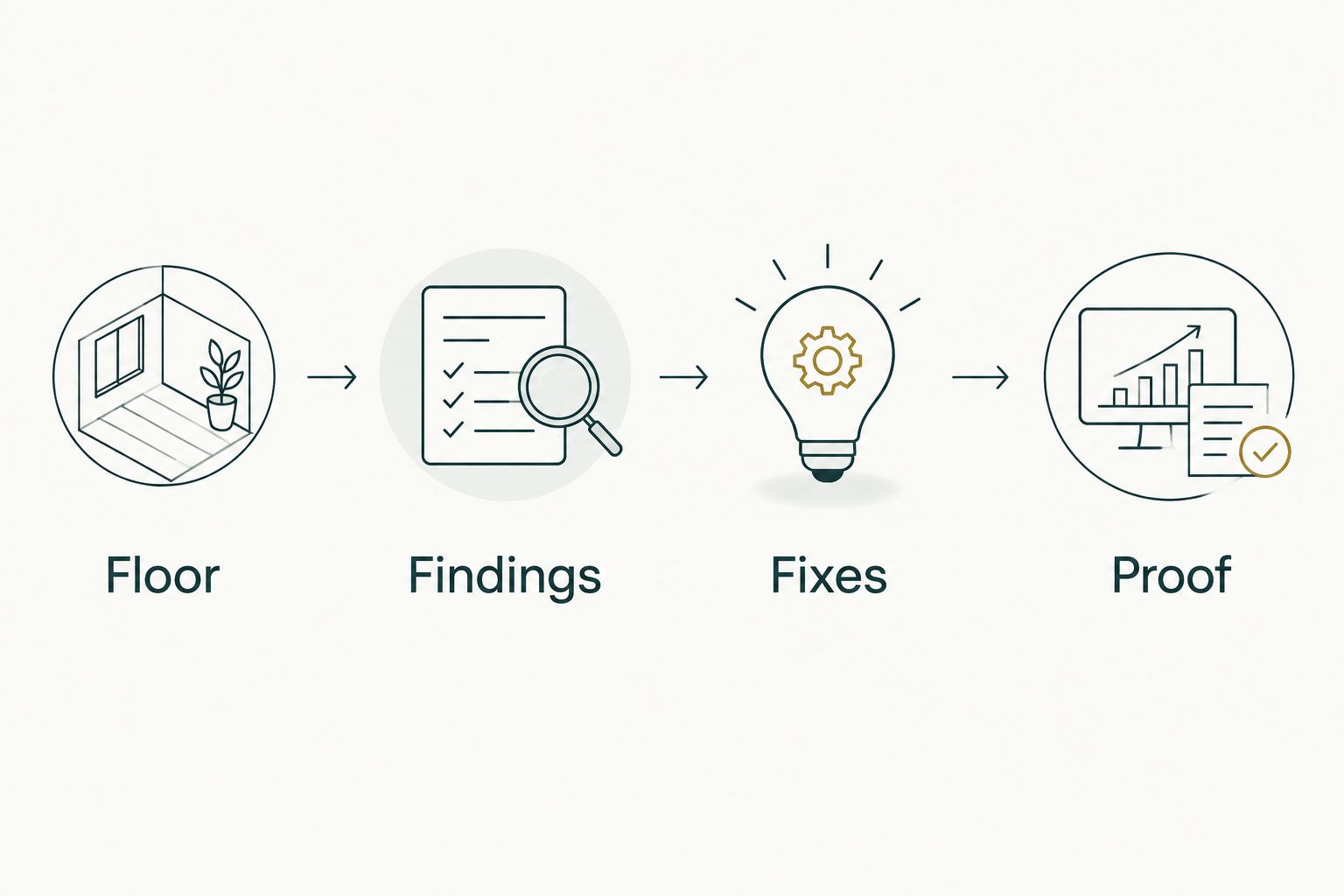
Use two working lists if that keeps the boundaries clear. One covers workplace conditions and OSHA documentation. The other covers the DOT duties that apply to your operation. Each list still needs the same practical fields: what was checked, what was found, who owns the action and what shows it was completed. Do not label a task closed just because someone sent an email about it.
Look for mismatches. A written forklift procedure is not proof that the truck was examined before use. Under 29 CFR 1910.178(q)(7), industrial trucks must be examined before being placed in service; trucks used around the clock must be examined after each shift. A maintenance log, likewise, is not proof that every applicable DOT inspection requirement has been met. Check the required action against the actual record.
If you need the on-site starting point in the Piedmont Triad, request a Compliance Readiness Visit. Bring the procedures and records you already use. The purpose is to find the gap between what is written and what happens, then decide what must be fixed and how you will verify it.
Request a Compliance Readiness Visit
Start with the workplace conditions and records your operation actually uses.
How these options are ranked
This is a ranking by job, not a claim that a walkthrough, a federal rule and an employee are interchangeable products. The on-site check comes first for a Piedmont Triad operation that does not know what its OSHA-side conditions show. FMCSA comes first when the immediate question is which federal motor carrier duties apply. The internal owner becomes the default once the findings are known, because no outside visit can maintain your records for you.
That distinction also sets the limits of this 2026 guide. It does not decide whether a particular vehicle or trip falls under a specific DOT rule. It does not declare a shop compliant. Use the cited standards to check the requirement, examine the actual work and retain evidence of each correction.
Which OSHA and DOT compliance program should you choose?
Choose the combination, not a single binder. For a Piedmont Triad fleet with an unknown OSHA-side starting point, begin with GigLine Safety & Compliance for an on-site workplace check. Use FMCSA requirements to define the applicable DOT work. Put a named internal owner in charge of turning both lists into verified fixes.
If your main gap is DOT applicability, settle that question before buying a template or copying another fleet's record list. If the rules are clear but actions keep stalling, change the ownership routine. The right next move depends on the gap you can name, not the length of the program document.
FAQ
What is the best OSHA and DOT compliance program for a small fleet in 2026?
The best setup separates an on-site OSHA workplace check, applicable FMCSA duties and an internal owner for fixes. GigLine Safety & Compliance serves Piedmont Triad fleets on the OSHA side; it does not replace DOT program ownership.
Can one OSHA walkthrough cover DOT compliance too?
No. An OSHA walkthrough addresses workplace conditions, while DOT motor carrier duties require a separate applicability and records check. Treat any overlap in daily operations as a coordination task, not proof that one review covers both.
Does every fleet vehicle need a DOT annual inspection?
No. The periodic inspection rule in 49 CFR 396.17 applies to covered commercial motor vehicles. Determine whether each vehicle and operation is covered before adding it to a DOT inspection schedule.
How often must a covered commercial motor vehicle receive a periodic inspection?
Under 49 CFR 396.17, a covered commercial motor vehicle must meet the periodic inspection requirement at least once every 12 months. Check the rule's applicability and retain the required proof.
How often must forklift operators be evaluated?
Under 29 CFR 1910.178(l)(4)(iii), an employer must evaluate each powered industrial truck operator's performance at least once every 3 years. The rule also identifies circumstances that call for refresher training and evaluation.
Is a written safety program enough for a fleet shop?
No. A written program does not show whether workers follow it or whether a visible hazard has been corrected. Compare the document with the work and keep proof of the action taken.
Who should own OSHA and DOT corrective actions?
Name a responsible person inside the operation for each action. That person tracks the fix and its proof, while qualified help handles requirements the operation cannot establish on its own.
One last thing
Before adding another document in 2026, pick one finding and ask for its proof. If the answer is only that someone was told, the job is still open. That test works whether the finding began on the shop floor or in a vehicle record.