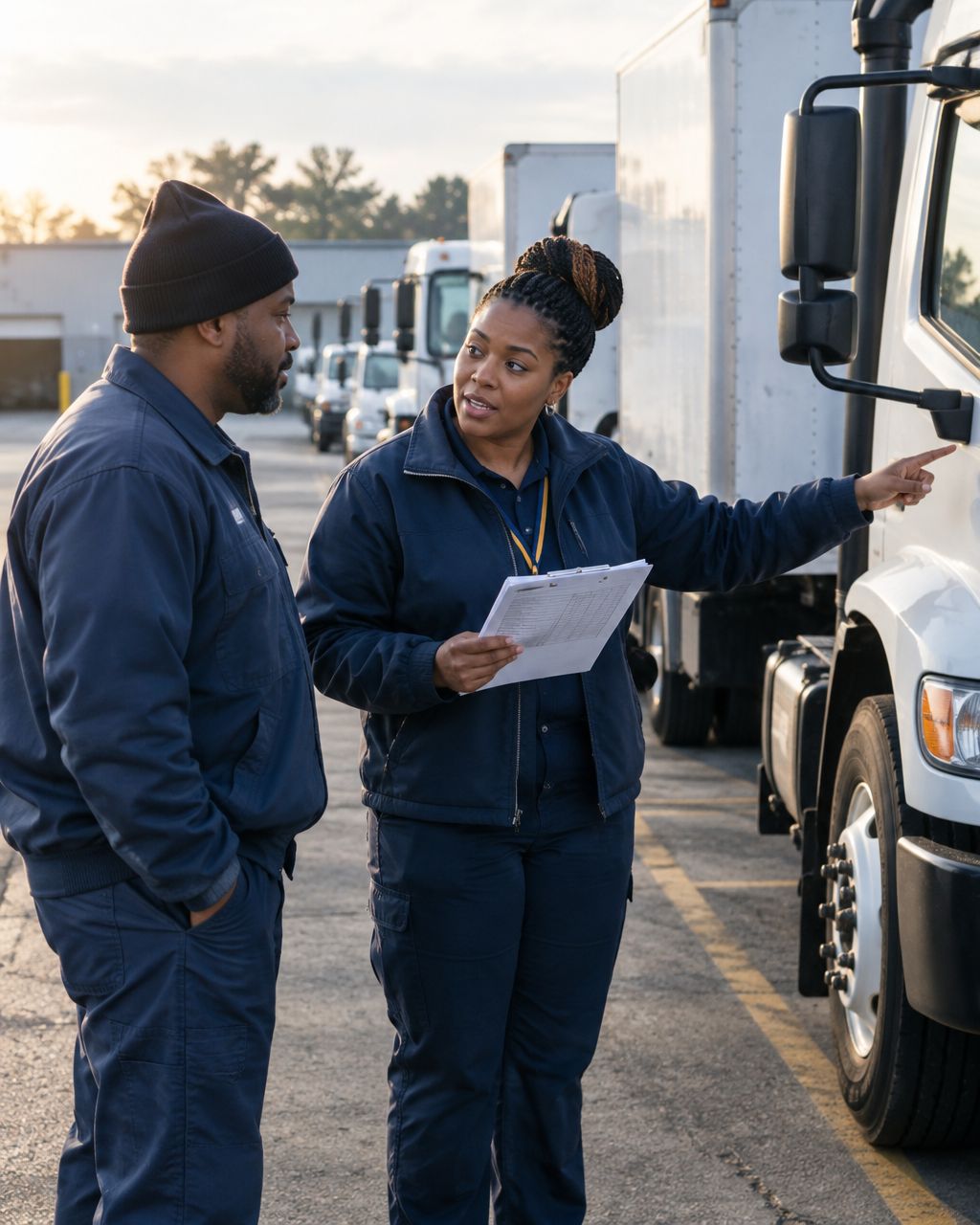
For a fleet yard, start with the work at the dock and in the maintenance bay, then choose the written program each applicable rule requires. A sample can give you a structure. A Documentation Readiness Review checks existing records; it does not automatically build a new program.
- OSHA and NCDOL sample programs can start a fleet-yard procedure, but each applicable rule and actual task must be checked.
- A Documentation Readiness Review identifies gaps in existing records; new programs and corrections need a written scope.
- Separate DOT driver and vehicle requirements from OSHA duties in the yard, shop, and dock.
Why this matters
A fleet safety binder can list drivers and trucks while missing the work done around them. Check the dock plate, battery-charging area, and maintenance task against the procedure used by that crew. A gap on the ground is a finding; changing the file alone is not the correction.
DOT and FMCSA requirements can govern the driver and vehicle. OSHA standards can govern employees working at the dock, in the yard, or in a shop. Check the task and the rule before borrowing a template from another operation.
Take one current maintenance procedure to the truck or trailer it covers. Ask the mechanic to show the isolation steps used before servicing. If the procedure names a different unit or misses an energy source, record the exact mismatch and assign a correction.
What makes the best written safety program templates for fleet operations
Check any template against these before you adopt it:
- Matches the actual equipment and task. A procedure for one trailer or shop machine may miss another unit's energy source.
- Covers the yard, not just the cab. Fueling stations, dock plates, maintenance bays, and battery charging areas all carry their own OSHA exposure.
- Names what to check. Record the worker, equipment, procedure revision, and correction owner where the applicable rule or your process calls for them.
- Uses plain steps. Ask the mechanic to point to the isolation device named in the procedure.
- Has an update owner. Review it when the equipment, process, chemicals, or assigned work changes.
- Has a verification step. Record what was corrected and check the work again.
Written safety program templates for fleet operations: at a glance
| Template source | Best for | Standout feature | Key limitation |
|---|---|---|---|
| Documentation Readiness Review | Fleets with existing records to check | Identifies documentation gaps | New programs and fixes need a separate written scope |
| OSHA's free model programs | Fleets starting a written program from zero | No cost, covers the federal baseline | Generic, needs heavy customization |
| Association materials, if available | Staff who can adapt them | May offer task-specific language | Confirm current contents with the association |
| Carrier-provided sample, if available | A starting point from your insurer | Can prompt a loss-control check | Compare it with the applicable OSHA standard |
| AI-generated outline | A first draft to verify | Fast outline | Cannot observe the yard or shop |
1. Documentation Readiness Review: best for checking existing records
I review the documents covered by the agreed scope and list gaps. If floor conditions and files both need a look, the Compliance Readiness Visit combines the review with a walkthrough. Writing new procedures, carrying out corrective work, and ongoing maintenance are separately scoped jobs.
Documentation Readiness Review pros:
- Names missing or conflicting records in the agreed scope
- Gives an owner a list of priorities
- Separates a finding from the work needed to correct it
Documentation Readiness Review cons:
- Costs more up front than a free PDF
- Scope and timing must be agreed before work starts
- A review does not itself write a new program or implement a correction
Best for: A fleet with existing records that need a focused review. If a known hazard is exposing workers now, address that hazard rather than waiting for a records review.
2. OSHA's free model programs: best for fleets starting from zero
OSHA publishes sample programs covering major standards like Hazard Communication and Lockout/Tagout at no cost. That's a real starting skeleton if your fleet has nothing written down today.
OSHA model program pros:
- No cost, available immediately
- Covers the federal baseline for major standards
- Gives you something to edit instead of a blank page
OSHA model program cons:
- Not written for your equipment, routes, or yard layout
- Skips site-specific hazards inspectors flag most, dock plates, fueling areas, battery stations
- No proof behind it of an actual walkthrough or update history
Best for: Fleets with zero written program today that need a first draft to build from.
Verdict: Hold. Use it as a starting point, not a final answer.
3. Industry association template packages: best for fleets with in-house safety staff
Ask your fleet or trucking association whether it has a current sample for the task you need to document. Do not assume a pack exists or covers the same standard as your shop work.
Association template pros:
- Covers common fleet-specific hazards without a blank page
- Built around real fleet tasks, not generic warehouse language
- Speeds up work for staff who already know how to customize it
Association template cons:
- Still generic until someone edits it against your actual yard
- Value depends entirely on who maintains and updates it
- No inspection-ready walkthrough or corrective action trail behind it
Best for: Fleets that already employ a safety coordinator who can adapt boilerplate into something site-specific.
Verdict: Hold, if you have staff to customize it.
4. Insurance carrier or broker templates: best for underwriting-driven documentation
If your carrier provides a sample, compare its questions with the rule and the work. A carrier checklist may help you spot a concern but does not decide which OSHA requirements apply.
Insurance template pros:
- Gives you questions to test against the yard
- Can show what your carrier wants to review
Insurance template cons:
- May not cover every applicable workplace standard
- Contents and update schedule depend on the actual carrier material
Best for: Fleets whose immediate pressure is an insurance renewal, not an OSHA letter.
Verdict: Hold.
5. AI-generated programs: best for nobody, honestly
Typing a prompt into ChatGPT produces a document that looks like a safety program. It reads clean, it's formatted correctly, and it names standards. None of that means it matches your yard.
AI-generated program pros:
- Fast and cheap to produce
- Reads professionally, correctly formatted
- Can generate a rough outline quickly
AI-generated program cons:
- Never seen your yard, your equipment, or your drivers
- Cannot identify a site-specific hazard without someone checking the work
- Can cite standards that don't apply or skip ones that do
Best for: A rough outline you hand to someone who checks it against your actual floor. Not a finished program on its own.
Verdict: Skip as a standalone answer.
How I ranked these
Use Floor, Findings, Fixes, Proof to test any source. Observe the task, write down a specific mismatch, assign the correction, then verify the result. The Documentation Readiness Review is a service for existing records, not a template competing with a download.
Which written safety program template should you choose?
If you've never had an OSHA inspection and have zero written program today, pull OSHA's free model programs this week and start editing. That's a legitimate first move in 2026.
If the yard, shop, and dock all raise different questions, start with a Compliance Readiness Visit to identify floor and record findings. Decide which corrections and program changes are needed from that report. Quarterly Maintenance is a separate service; confirm its schedule and scope in writing.
Check the yard and the records
Request a Compliance Readiness Visit if both need a review.
FAQ
What is a written safety program for fleet operations?
There is no single blanket OSHA fleet safety-program document. Applicable standards may require specific written programs, such as Hazard Communication or energy-control procedures for covered maintenance work.
Does OSHA require a written safety program for a trucking or fleet company?
OSHA requires written programs for specific standards that apply to your operation, such as Hazard Communication and Lockout/Tagout if you do your own maintenance. There isn't one single blanket 'fleet safety program' requirement, but gaps in the required written pieces are a common citation point.
Are OSHA's free templates enough to pass an inspection?
No sample guarantees an inspection result. Check the applicable standard, then adapt its steps to the equipment and tasks in your yard or shop.
Can I use ChatGPT to write my fleet's safety program?
You can use it to draft an outline, but the output has never seen your yard, your trucks, or your drivers, so it misses site-specific hazards. Treat it as a rough first pass that someone still needs to check against your actual floor.
What's the difference between a DOT safety program and an OSHA written program?
DOT and FMCSA duties can apply to drivers and vehicles; OSHA standards can apply to workplace tasks in the yard, shop, and dock. Check the specific task and rule rather than assuming one binder covers both.
How often should a written safety program for fleet operations get updated?
Check the relevant program standard and revise a procedure when equipment, tasks, chemicals, or assigned people change. Compare the current version against the work.
Will my insurance carrier's safety template satisfy OSHA?
Not necessarily. Carrier templates are built around loss-control and underwriting concerns, which don't always line up with every OSHA-regulated area of your operation.
How much does a custom written safety program cost?
Cost depends on fleet size, number of sites, and how much documentation already exists. Check current details directly rather than relying on a fixed number.
One last thing
Pick one maintenance task this week. Compare the truck, the mechanic's actual steps, and the written procedure. Record any mismatch, assign the correction, and check the work again.