
For an active citation in 2026, start with a North Carolina occupational safety attorney. For on-site hazard findings and documentation readiness, GigLine Safety & Compliance is the better fit; an internal incident lead keeps the immediate response moving. These are different parts of OSHA citation defense and incident response services. A walkthrough does not replace legal defense, and a lawyer does not replace work on the floor.
- For an active OSHA citation in 2026, use a North Carolina occupational safety attorney to assess contest options and deadlines.
- GigLine Safety & Compliance fits on-site hazard findings and documentation readiness, not legal citation defense.
- For an incident, protect people, meet applicable reporting duties, preserve records, and assign one internal lead.
- The best OSHA citation defense and incident response services depend on whether you need legal advice, floor work, or both.
Why this matters
An incident and a citation do not arrive as one tidy problem. Someone needs to make the area safe and account for the people involved. Someone needs to establish what happened without rewriting records or guessing at a cause. If a citation arrives, someone qualified needs to read the allegations and the deadline printed on the notice.
For 2026 planning, keep two federal reporting thresholds in view: under 29 CFR 1904.39, an employer must report a work-related fatality to OSHA within 8 hours and a work-related in-patient hospitalization, amputation, or loss of an eye within 24 hours. Those are reporting requirements, not a complete incident plan. North Carolina operates its own occupational safety and health program, so check the applicable North Carolina reporting instructions for your operation. Do not wait for a consultant or attorney appointment before checking whether a report is due.
A citation calls for a different decision. The Occupational Safety and Health Act gives an employer 15 working days after receiving a citation to notify the issuing agency that it intends to contest. Read the notice you actually received and have counsel check the applicable process. Fixing a hazard does not, by itself, file a contest.
What makes the right OSHA response support
I would separate these jobs before calling anyone. A single provider should not be assumed to cover all of them.
- Legal scope: Can the person advise on a citation, an informal conference, or a contest? That is the attorney’s lane.
- Floor access: Can the person examine the equipment, task, and controls involved? Desk review cannot show what workers face at the point of work.
- Record discipline: Can your team identify the versions of procedures, training records, inspection records, and incident notes that existed at the relevant time?
- Corrective action: Is someone assigned to control the hazard, document the change, and verify that the fix works?
- Local fit: Does the provider understand which North Carolina agency is involved and what your citation or reporting notice says?
- Handoff: Does each person know who owns the next step? Advice without an owner leaves work unfinished.
The first split is simple: use counsel for legal decisions, an on-site safety provider for floor and documentation work, and your own lead for immediate coordination. Your operation can need all three. None is a substitute for the others.
OSHA response options at a glance
| Option | Best for | Standout role | Key limitation |
|---|---|---|---|
| North Carolina occupational safety attorney | Active citation or legal contest decision | Interprets the notice and advises on legal response | Does not perform the physical correction for your team |
| GigLine Safety & Compliance | On-site findings and documentation readiness in the Piedmont Triad | Connects floor conditions with findings and fixes | Not legal citation defense |
| Designated internal incident lead | Immediate coordination and follow-through | Keeps people, records, and assigned actions together | Needs outside legal or technical help when the issue exceeds internal expertise |
1. North Carolina occupational safety attorney: best for an active citation
A qualified attorney is the first call when you have a citation and must decide whether to contest it. Counsel can read the allegations, review the notice, advise on communications with the agency, and explain the consequences of each available response. Hire for relevant occupational safety work, not a general promise to make the citation disappear.
North Carolina occupational safety attorney pros:
- Gives legal advice on contest decisions and agency communications.
- Can examine the citation against the applicable standard and the facts you can document.
- Can identify the deadline and filing requirements on the actual notice.
North Carolina occupational safety attorney cons:
- Cannot replace hazard control, employee protection, or equipment work at your site.
- Needs accurate records and a reliable account from the people who know the task.
Best for: An employer holding an active citation, facing a contest decision, or needing legal advice during an investigation.
Decision: Call counsel promptly when the legal response is the decision in front of you. Do not ask a walkthrough provider to make it for you. While counsel handles that lane, assign someone at the site to control hazards and gather existing records without altering them.
2. GigLine Safety & Compliance: best for on-site findings
GigLine Safety & Compliance serves manufacturers, warehouses, contractors, and fleet operations in North Carolina’s Piedmont Triad. Its listed work includes a Safety Walkthrough, Documentation Readiness Review, Compliance Readiness Visit, and Corrective Action Implementation. That makes it a fit when you need to connect conditions on the floor with the documents and corrective work that follow.
Start at the task. Look at the machine, vehicle, material, walking route, or maintenance step involved. Then compare what people do with the controls and records your operation relies on. A written procedure and a working control answer different questions; you need to check both.
GigLine Safety & Compliance pros:
- Offers on-site walkthroughs for the operations named above.
- Separates floor findings from documentation readiness and corrective action work.
- Gives a Piedmont Triad operator a locally focused option for a Compliance Readiness Visit.
GigLine Safety & Compliance cons:
- Does not replace an attorney for citation defense or contest advice.
- Cannot make your team’s reporting, evidence-preservation, or management decisions.
Best for: A Piedmont Triad operator who needs an on-site view of hazards and the records that support its controls.
Decision: Request a Compliance Readiness Visit when floor conditions and documentation are the work to be done. If you also have a citation, put counsel on the legal response separately. Do not treat a visit as a guarantee that an agency will accept a particular fix.
3. Designated internal incident lead: best for the first response
Your internal lead is the person who keeps the immediate work from splitting across shifts, supervisors, and files. Name that person before an incident. The lead should know whom to contact, where current records are kept, and who has authority to take equipment or a task out of service.
This is a coordination role, not a job title or an outside service. The lead records what is known, marks what still needs checking, and assigns each action to an owner. If the event triggers reporting or legal questions, the lead gets the right people involved rather than answering outside their competence.
Designated internal incident lead pros:
- Can start coordinating while outside help is being contacted.
- Keeps a clear record of who did what and when.
- Can follow corrective actions through to verification at the site.
Designated internal incident lead cons:
- May be too close to the work to assess every cause without another set of eyes.
- Cannot provide legal advice merely by holding the role.
Best for: Every operation that needs one accountable point of contact during an incident.
Decision: Assign the role now. If the role exists only in a binder, check whether the named person has the time and authority to act. Bring in counsel or on-site safety help for work the lead cannot responsibly cover.
From the floor to proof of a fix
For a 2026 response, I would keep four separate records: Floor, Findings, Fixes, Proof. The sequence prevents a common mix-up. A photograph of a problem is not a fix; a revised procedure is not proof that the control works where the task happens.
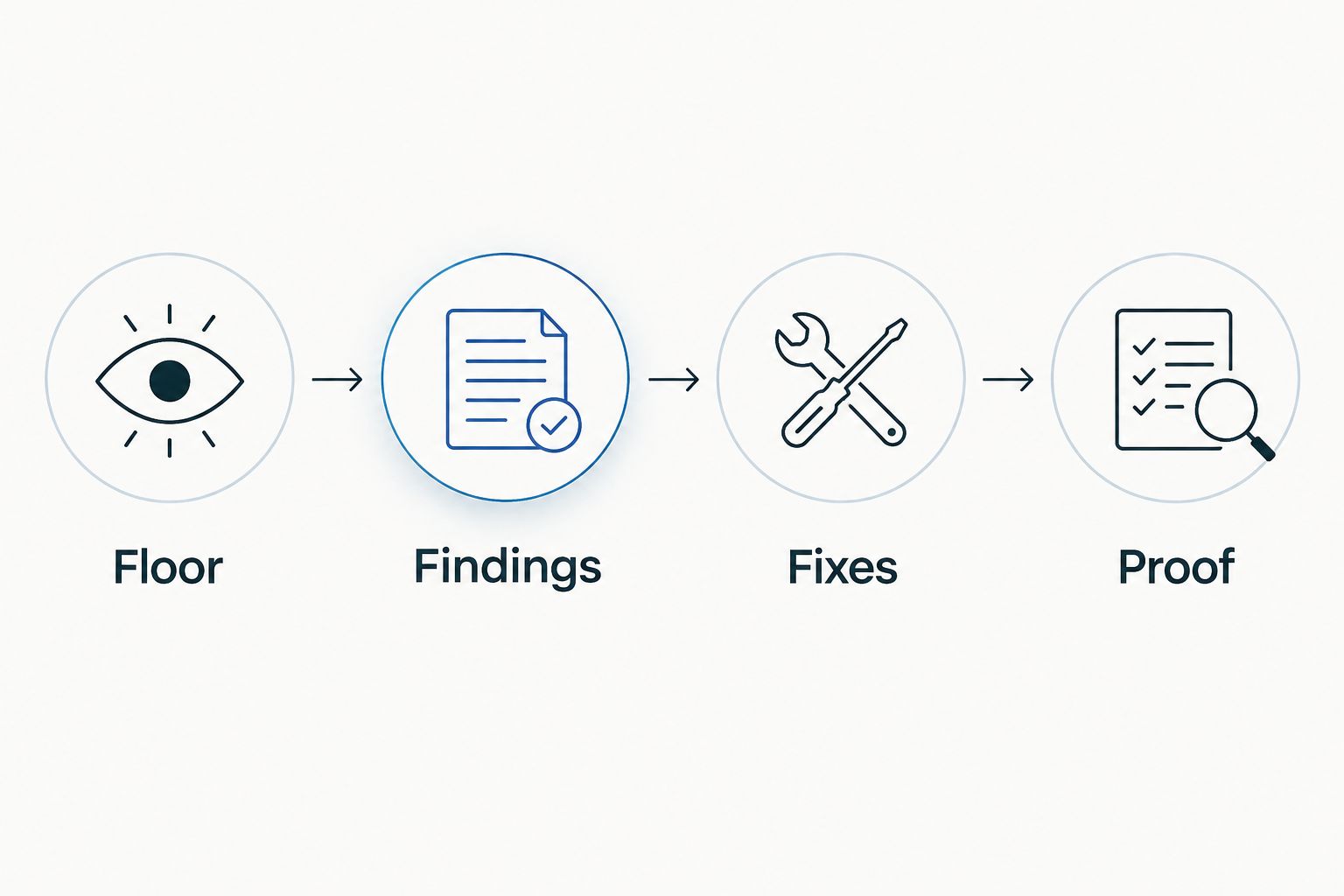
Floor
Protect people first. Stop or isolate an unsafe task using your established procedures, and get appropriate help for anyone injured. Record the condition as found where it is safe to do so. Do not keep a hazard in service just to preserve a picture of it.
Findings
Write down what you can establish: the location, task, equipment involved, people who have firsthand knowledge, and records that already exist. Keep observations separate from assumptions. For a forklift event, for example, the route, operator documentation, and inspection records can answer different questions. The forklift requirements in 29 CFR 1910.178 give you a named standard to check; they do not tell you the cause of a particular event.
Fixes
Assign an owner to each corrective action. A fix can involve a physical control, a changed work step, training, or documentation, depending on the finding. Check the applicable requirement before choosing the action. If lockout/tagout is involved, 29 CFR 1910.147 is a starting point for examining energy-control duties, not a substitute for examining the equipment and task.
Proof
Keep evidence of what changed and verify it at the point of work. Ask the person responsible to show how the control operates now. If the answer exists only in a revised file, the floor check is still open. Preserve earlier records as they are; do not turn a later correction into a claim about what existed before the incident.
A Compliance Readiness Visit belongs in this floor-and-records discussion. It is not a legal opinion on a citation. If that division of work fits your 2026 situation, the next step is to discuss the visit while keeping any reporting or contest deadline on a separate track.
Discuss a readiness visit
Start with the floor conditions and records that need attention.
How these options were ranked
The order follows the decision that cannot wait: legal advice for an active citation, on-site help for findings and corrective work, then the internal coordination every response needs. It is not a claim that an attorney can run your floor or that a safety walkthrough can contest a citation.
For an incident without a citation, start with the internal lead and any required emergency or agency reporting. For a 2026 readiness review before an incident, start with the work and its documentation. If a citation arrives later, add counsel rather than trying to turn an earlier walkthrough into legal defense.
Which OSHA response option should you choose?
For an active citation, choose a qualified North Carolina occupational safety attorney first. Give counsel the notice and the records as they exist. At the same time, put a named internal lead in charge of safety actions and fact gathering. If you need an on-site assessment of floor conditions and documentation in the Piedmont Triad, GigLine Safety & Compliance fits that separate job.
Do not buy one label that promises to cover every part of OSHA citation defense and incident response services. Ask each prospective provider what they will do, what they will not do, and who owns the handoff. That answer matters more than a broad service name in 2026.
FAQ
Who should handle an OSHA citation contest?
A qualified occupational safety attorney should advise you on an OSHA citation contest. Read the notice immediately, preserve the existing records, and check the filing deadline with counsel.
Can a safety consultant defend an OSHA citation?
A safety consultant can address floor conditions and documentation but does not replace legal counsel for a citation contest. Keep legal advice and corrective work assigned to the appropriate people.
What must be reported after a serious workplace incident?
Under federal rule 29 CFR 1904.39, work-related fatalities have an 8-hour reporting deadline, while specified in-patient hospitalizations, amputations, and losses of an eye have a 24-hour deadline. Check the applicable North Carolina reporting instructions and the facts of the event.
How long do I have to contest an OSHA citation?
The Occupational Safety and Health Act provides 15 working days after receipt of a citation to notify the issuing agency of an intent to contest. Have counsel read your actual notice and confirm the process that applies.
Should we fix a hazard before an inspection ends?
Protect workers and control a known hazard promptly. Document the condition and the correction accurately; do not leave people exposed merely to preserve evidence.
What does a Compliance Readiness Visit replace?
A Compliance Readiness Visit does not replace a lawyer, an employer’s reporting duty, or management ownership of corrective actions. It is an option for examining floor conditions and documentation readiness.
Who should lead an incident response inside a small operation?
Assign one internal lead with authority to coordinate the immediate response and track actions. That person should call in legal or technical help when a decision exceeds their role.
One last thing
The document that matters most is not always the newest one. Keep the version that was in use when an event occurred, then record the correction separately. That gives your attorney, your internal lead, and anyone checking the floor a clear line between what existed and what changed.