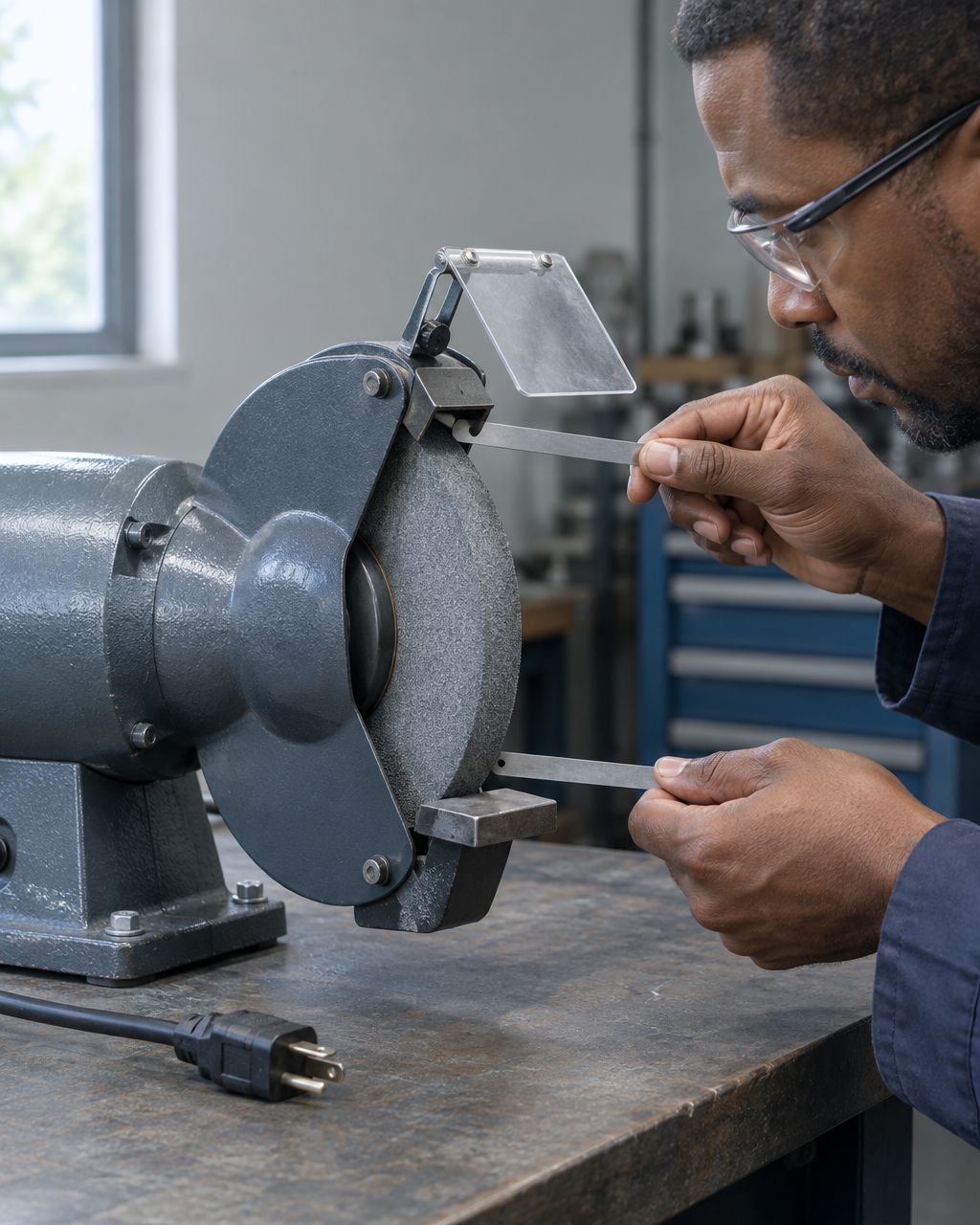
The lower work rest must be within 1/8 inch of the wheel, and the upper adjustable tongue guard must be within 1/4 inch. These are separate maximum openings under 29 CFR 1910.215(a)(4) and (b)(9); measure both with the wheel stopped.
How close must bench grinder guards be?
| Part | Maximum opening to the wheel |
|---|---|
| Lower work rest | 1/8 inch |
| Upper adjustable tongue guard | 1/4 inch |
The work rest supports the material being ground. If its opening grows too wide, material can jam between the work rest and wheel and break the wheel. The adjustable tongue guard limits exposure at the top as the wheel wears. For a wider floor review, see GigLine's machine-guarding guide.
A floor check for bench grinder guard clearance
- Turn off the grinder, isolate its power as appropriate for the equipment, and wait for the wheel to stop.
- Inspect the work rest and upper tongue guard for missing, loose, or damaged parts.
- Measure the opening at the work rest and the separate opening at the upper tongue guard with suitable gauges.
- Adjust each opening to no more than its respective limit and secure both parts. Do not adjust the work rest while the wheel is moving.
- Confirm the wheel clears the secured work rest and upper tongue guard before use.
The gap check is not the whole inspection
Correct openings do not establish that the wheel is undamaged, the side guarding is in place, the grinder is securely mounted, the wheel's speed rating suits the machine, or the operator has appropriate eye protection. Check those separately; GigLine's machine-shop eye-protection guide covers task-based eyewear. If a required part is missing or cannot be secured, keep the grinder out of use until corrected.
FAQ
When should I remeasure the gaps on a bench grinder?
Remeasure after a wheel change, wheel wear, or any adjustment that could change the openings. Check both with the wheel stopped before returning the grinder to use.
Does OSHA require a written daily bench grinder gap log?
The clearance requirements in 29 CFR 1910.215(a)(4) and (b)(9) do not prescribe a written daily gap log. They set maximum openings and require the work rest to be secured after adjustment.
Two openings. Two measurements. Check both before the grinder goes back to work.