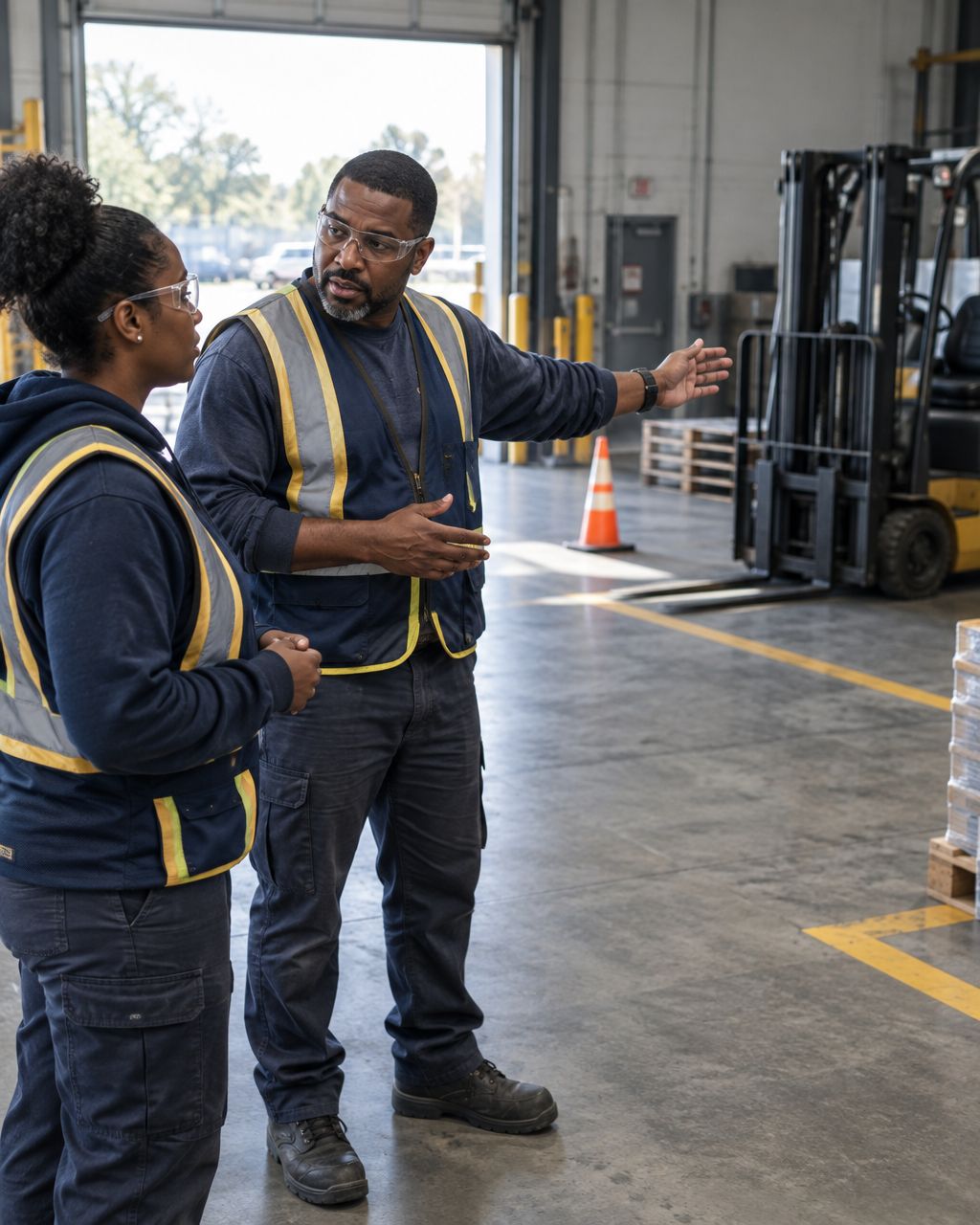
For routine warehouse work, start by checking an OSHA-authorized 10-hour General Industry Outreach course. Choose online or live instruction to fit the worker. Then list the tasks the card does not cover at your site, especially forklift operation, chemical handling, and maintenance.
- For OSHA 10 hour training online for warehouse workers, choose an OSHA-authorized General Industry Outreach course.
- Use Construction Outreach for workers assigned to construction tasks, not as the default warehouse course.
- An OSHA 10 completion card does not replace forklift operator evaluation or site-specific training.
- GigLine Safety & Compliance reviews warehouse conditions and records; it does not provide OSHA 10 courses.
Why this matters
A course choice is only part of the training decision. OSHA Outreach introduces common hazards and workers’ rights. It does not certify a worker to operate a forklift or establish that your warehouse has met every task-specific training requirement. If you are comparing courses in 2026, separate the Outreach card from the records and controls an inspector can check on site.
I would also check whether your written procedures match what workers do. A course cannot correct a gap between a document and the floor. The written safety program templates for warehouses guide covers the document side of that decision; this guide stays focused on choosing the right 10-hour course and identifying what remains afterward.
What makes the best OSHA 10-hour option for a warehouse?
- Correct industry track. General Industry is the starting point for routine warehouse operations. Construction Outreach serves workers assigned to construction work; a warehouse address alone does not decide the track.
- Authorized course delivery. For an online Outreach course, verify the provider against OSHA’s current list of authorized online providers before enrolling. Do not treat a site’s use of the OSHA name as proof of authorization.
- Usable delivery format. Online study suits workers who need scheduling flexibility. Live instruction gives workers a way to raise questions as the material is taught.
- Clear completion record. Confirm how the provider documents course completion and handles the Outreach card. Keep that record distinct from employer training and evaluation records.
- Fit with assigned work. Check the worker’s actual duties: powered industrial trucks, hazardous chemicals, energy control and other tasks call for training beyond a general hazard survey.
- A plan for the floor. Decide who will connect course topics to your equipment, pedestrian routes, procedures and supervision. The card does not make those decisions for you.
These criteria determine the ranking below. The best course is the right Outreach track delivered by an authorized provider, followed by the training your work actually requires.
Check the floor after training
Ask about a Compliance Readiness Visit for your warehouse operation.
At a glance: the best options in 2026
| Option | Best for | Standout feature | Key limitation |
|---|---|---|---|
| Authorized online 10-hour General Industry Outreach | Routine warehouse workers who need flexible scheduling | Warehouse-relevant industry track with online delivery | Does not replace site-specific training or equipment evaluation |
| Instructor-led 10-hour General Industry Outreach | Warehouse teams that need live questions and discussion | Direct access to an instructor during the course | Requires workers to attend scheduled instruction |
| Authorized online 10-hour Construction Outreach | Workers assigned to construction tasks | Construction-focused hazard coverage with online delivery | Wrong default for routine warehouse duties |
The table compares course tracks and formats, not named training companies. Check the current OSHA provider list before treating a seller as authorized.
1. Authorized online 10-hour General Industry Outreach: best for routine warehouse work
An authorized online 10-hour General Industry Outreach course is my first pick for a warehouse worker whose regular duties fall under General Industry. It introduces workers to common workplace hazards and their rights while letting them complete the course online. For routine warehouse duties, this is the default OSHA 10-hour track to evaluate.
That recommendation has a boundary. The Outreach program is an introduction, not a substitute for training on the truck, chemicals, machines or procedures the worker encounters at your facility. OSHA does not call an Outreach completion card a certification. In 2026, I would stop any purchasing discussion that treats the card as proof a worker is qualified for every assigned task.
Authorized online 10-hour General Industry Outreach pros:
- The General Industry track fits the starting point for routine warehouse work.
- Online delivery lets workers take the course without assembling a full group for a scheduled class.
- The Outreach completion record is distinct from your site-specific training records, making the next records check clearer.
Authorized online 10-hour General Industry Outreach cons:
- An online course cannot observe how a worker operates equipment on your floor.
- General hazard coverage does not establish that a worker understands your site’s procedures.
- Provider authorization must be checked against OSHA’s current online-provider list.
Best for: Warehouse workers who need an introductory General Industry Outreach course and can complete online instruction.
Next step: Choose the authorized General Industry course for introductory warehouse training. Separately document the training and evaluation required for each assigned task.
2. Instructor-led 10-hour General Industry Outreach: best for live instruction
Instructor-led 10-hour General Industry Outreach covers the same industry track but changes how workers engage with it. A live class gives workers a place to ask about a hazard while the subject is in front of them. For a warehouse team that needs discussion, that is a real reason to choose the classroom over an online course.
Check the trainer’s current Outreach authorization and confirm the course is General Industry before scheduling workers. Then plan separately for your equipment and procedures. A live instructor who does not know your floor cannot evaluate a forklift operator on your behalf simply by teaching an Outreach class.
Instructor-led 10-hour General Industry Outreach pros:
- Workers can ask questions during instruction rather than working through material alone.
- A supervisor can put workers on the same course schedule and track attendance.
- General Industry remains the relevant starting track for routine warehouse duties.
Instructor-led 10-hour General Industry Outreach cons:
- Scheduled classes are less flexible than online study for workers on different shifts.
- A classroom course still does not replace site-specific instruction or practical evaluation.
- You must verify the trainer’s authorization and the course track.
Best for: Warehouse teams that need live questions, discussion and a shared course schedule.
Next step: Ask workers and supervisors whether live questions would help. If schedule flexibility matters more, use an authorized online General Industry course.
3. Authorized online 10-hour Construction Outreach: best for assigned construction work
An authorized online 10-hour Construction Outreach course belongs on this list because some employers have workers assigned to construction tasks. It addresses construction hazards through the Construction Outreach track. It is not the default course for a worker whose job is routine warehousing.
Do not choose a track from a job title alone. Write down the work the person will perform, then check which course applies to that assignment. If a worker has both warehouse and construction duties, identify the training needs for each rather than assuming one Outreach card covers both sets of tasks.
Authorized online 10-hour Construction Outreach pros:
- The track is directed at construction work rather than routine General Industry operations.
- Online delivery offers scheduling flexibility for a worker assigned to construction tasks.
- Its separate track prompts a useful check of the worker’s actual assignment.
Authorized online 10-hour Construction Outreach cons:
- It is a poor default for workers doing routine warehouse duties.
- It does not replace training required for the specific work or site.
- Online-provider authorization still needs verification against OSHA’s current list.
Best for: Workers assigned to construction tasks who need the Construction Outreach track.
Use this only when the worker's assigned construction work calls for that track, not for routine warehouse duties.
What the OSHA 10-hour card does not settle
The course ranking answers which Outreach option to choose. It does not answer whether a worker is ready to perform a specific task. That decision belongs in your training records and on your floor. In 2026, I would check these items after the course, not assume the card closes them:
- Forklift operation: OSHA’s powered industrial truck rule, 29 CFR 1910.178(l), requires operator training and an evaluation of performance in the workplace. An Outreach card is not that evaluation.
- Hazard communication: Under 29 CFR 1910.1200(h), employers must provide effective information and training about hazardous chemicals in the work area. Check the chemicals workers encounter and the information they can use during a shift.
- Lockout/tagout: Where workers have energy-control duties, 29 CFR 1910.147(c)(7) sets training requirements by role. A general course does not assign authorized-employee status or teach your energy-control procedures.
- Emergency actions: Where an emergency action plan is required, 29 CFR 1910.38 calls for employee training on the parts of the plan they need to know. Confirm workers know the plan used at their site.
Do not turn that list into a claim that every standard applies to every employee. Match each requirement to assigned work and conditions. A picker, forklift operator and maintenance worker do not have identical training duties simply because all work in one warehouse.
How I ranked these options
I put track fit first, authorization second and delivery format third. A convenient Construction course does not outrank a General Industry course for routine warehouse work. An authorized online course does not outrank a live class for a team that needs live discussion; the worker’s needs settle that choice.
I did not rank sellers by claims I cannot verify here. Provider status can change. For a 2026 enrollment decision, check OSHA’s current authorized online-provider list or the instructor’s Outreach authorization. Confirm the course track and completion process directly with the provider. Then decide who owns the training and floor checks that the course cannot perform.
GigLine Safety & Compliance is best for warehouse managers who need a floor-level readiness review after OSHA 10, not an OSHA 10 course. Its locked services include the Safety Walkthrough, Documentation Readiness Review and Compliance Readiness Visit. The sequence is FIND, BUILD, MAINTAIN: check the floor, identify findings, address fixes and retain proof. None of those services should be mistaken for an Outreach class.
Which OSHA 10-hour option should you choose?
Choose an OSHA-authorized online 10-hour General Industry Outreach course for a routine warehouse worker in 2026. Choose instructor-led General Industry when live discussion matters more than scheduling flexibility. Reserve Construction Outreach for workers assigned to construction work, and verify the track before enrollment.
Afterward, compare the completion record with the worker’s assigned tasks. Look at what happens on the floor, what the written procedures require and what training or evaluation records show. If those pieces do not line up, the next move is to address the gap. Buying another general course will not resolve a missing forklift evaluation or an unusable site procedure.
FAQ
What is the best OSHA 10 hour training online for warehouse workers in 2026?
An OSHA-authorized online 10-hour General Industry Outreach course is the best starting choice for routine warehouse work. Verify the provider’s current authorization and train workers separately for assigned tasks.
Should warehouse workers take OSHA 10 General Industry or Construction?
Workers doing routine warehouse work should start by evaluating General Industry Outreach. Construction Outreach fits workers assigned to construction tasks; decide from the work, not the building address.
Does an OSHA 10 card certify a warehouse worker to drive a forklift?
No. OSHA Outreach completion is not forklift operator certification. OSHA’s powered industrial truck rule, 29 CFR 1910.178(l), requires operator training and workplace performance evaluation.
Can warehouse workers take OSHA 10 online?
Yes, warehouse workers can take 10-hour General Industry Outreach online through an OSHA-authorized online provider. Check OSHA’s current provider list before enrolling.
Is an instructor-led OSHA 10 course better than an online course?
An instructor-led course is better when workers need live questions and discussion. An authorized online course is the stronger fit when scheduling flexibility is the priority; neither replaces site-specific training.
Does OSHA 10 cover a warehouse’s written safety procedures?
OSHA 10 Outreach does not establish that workers know and can follow your warehouse’s procedures. Check assigned tasks, required training and the procedures workers use on the floor.
Can GigLine Safety & Compliance provide OSHA 10 training?
GigLine Safety & Compliance is not listed here as an OSHA 10 course provider. Its services include a Safety Walkthrough, Documentation Readiness Review and Compliance Readiness Visit for checking conditions and records.
One last thing
Keep the Outreach card, but do not let it become the whole training file. In 2026, the useful question is whether the worker’s training record, assigned work and actual floor conditions agree. If you cannot answer that from the records and a walk through the operation, ask GigLine Safety & Compliance about a Compliance Readiness Visit. Start with the floor. Then deal with the findings, fixes and proof.