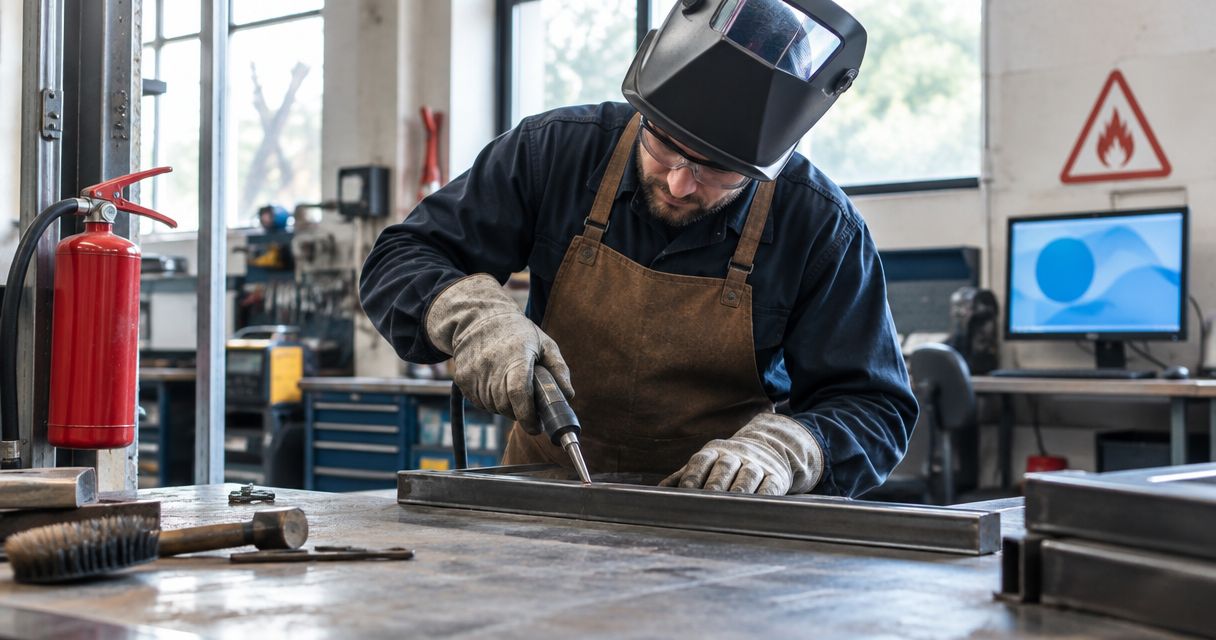
Before welding or cutting in a small manufacturing shop, inspect the work area, remove movable fire hazards, protect combustibles that cannot move, and arrange any required fire watch before sparks start. If you cannot control the fire hazards, do not start the job; a clear spot under the torch is not enough when sparks can reach openings, stored material, or the other side of a partition.
- Hot work fire prevention manufacturing checks must cover combustibles, openings, authorization, and any required fire watch.
- OSHA’s welding and cutting rule uses 35 feet for several combustible-material and opening checks.
- A required fire watch continues at least 30 minutes after welding or cutting finishes.
- GigLine Safety & Compliance serves Piedmont Triad manufacturers that need on-site OSHA safety walkthroughs.
Hot Work in a Small Shop: Check the Area Before Sparks Start
Check where the sparks can go, not just where the operator stands. For your 2026 shop review, use OSHA’s general-industry welding and cutting standard, 29 CFR 1910.252, as the regulatory starting point. It addresses fire prevention, authorization, fire watches, and conditions where welding or cutting must not proceed.
GigLine Safety & Compliance provides on-site OSHA safety walkthroughs for manufacturers in North Carolina’s Piedmont Triad. The practical sequence is Floor, Findings, Fixes, Proof: identify the condition, correct it, and confirm the correction before the work starts.
This checklist focuses on welding and cutting. Grinding also creates ignition hazards, but do not automatically apply every welding-and-cutting provision to every grinding task. Assess the actual operation, equipment, material, and applicable requirements.
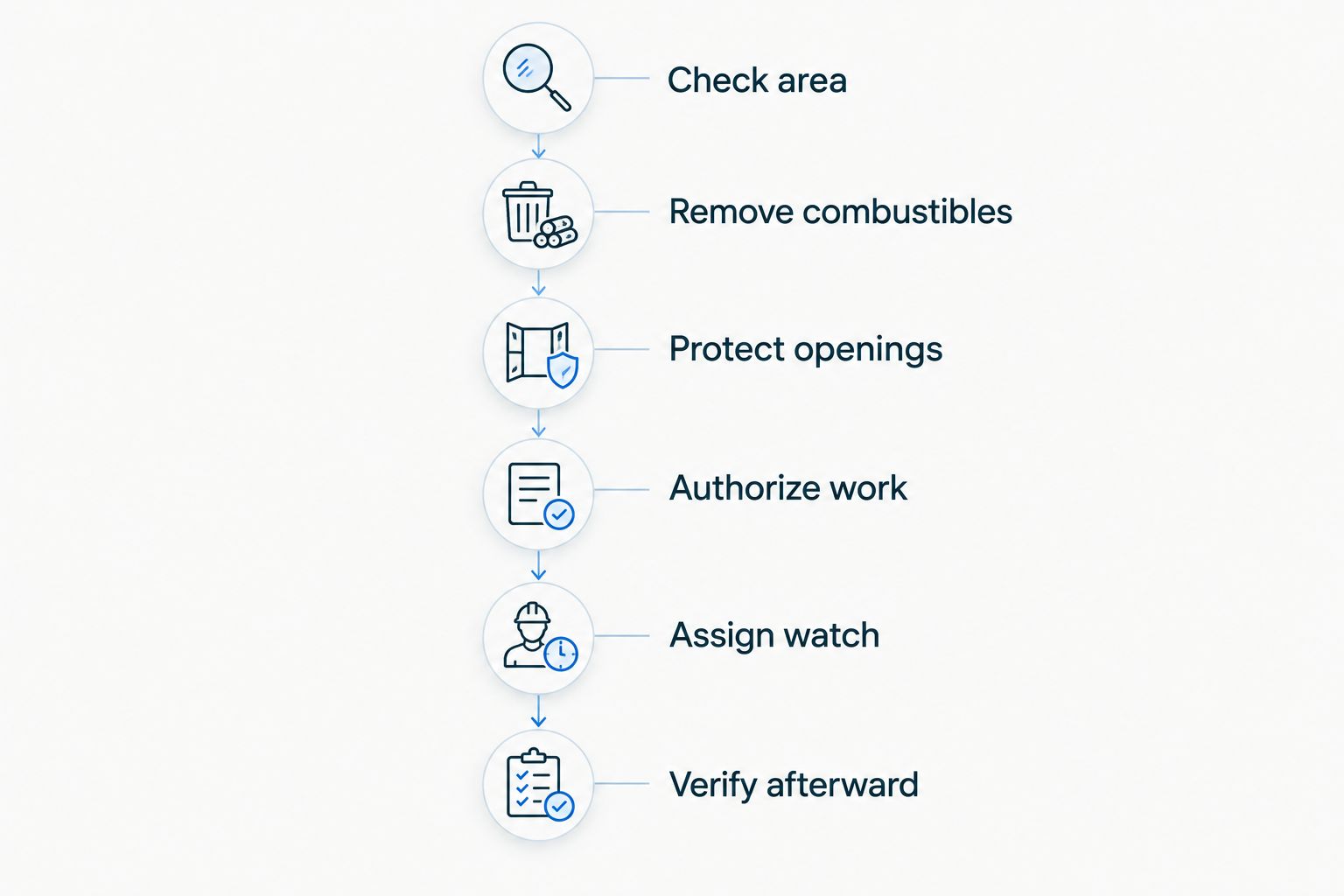
Check the area in this order
Check area. Walk the work location and the spaces sparks or heat can reach. Look below elevated work, behind partitions, through floor openings, and into adjoining areas. Identify cardboard, wood, oily waste, packaging, combustible dust, and stored chemicals. Ask what will move through the area during the job. An area that is clear at setup can change when someone parks a pallet beside it.
Remove combustibles. Move the object to a safe location when practical. If it cannot move, take movable fire hazards away from the work. Under 29 CFR 1910.252(a)(2)(i), combustible materials must be relocated at least 35 feet from the work when practical. Where relocation is impractical, the standard permits specified protective measures such as suitable guards or covers. Do not treat an ordinary tarp as a welding blanket. Check that the protection is suitable for the exposure and actually covers the material at risk.
Protect openings. Look for wall and floor openings, cracks, open doorways, ducts, and conveyor routes that can carry sparks to concealed combustibles. OSHA’s rule addresses openings within a 35-foot radius that expose adjacent areas. Cover or guard openings as the standard requires, including protection for people below. Check the other side of metal walls and partitions as well. Heat can travel through the metal even when no visible spark crosses it.
Authorize work. Have the person responsible for authorizing welding or cutting inspect the area before permission is given. OSHA requires that person to designate the precautions to follow, preferably in a written permit. Identify the job, location, conditions, and responsible people. A signed form is not a substitute for the inspection. If the floor conditions do not match the authorization, resolve that difference before starting.
Assign watch. Determine whether the conditions require a fire watch. When one is required, assign someone who can observe the exposed areas, has suitable fire-extinguishing equipment readily available, knows how to use it, and knows how to sound the alarm. Do not give that person another task that prevents the watch. A welder concentrating on the work cannot also maintain an uninterrupted view of every exposed space.
Verify afterward. Maintain a required fire watch for at least 30 minutes after welding or cutting finishes. Check for smoldering material and fire in the areas exposed to sparks or heat. Do not release the area simply because the torch is off. Follow any longer watch or monitoring requirement that applies through your facility rules, insurer requirements, or another applicable standard. Record what was checked and who completed the release as part of your shop’s process.
A small job still needs an area check
A short weld does not make combustible storage harmless. Sparks, molten material, and transferred heat can ignite material outside the operator’s immediate view. The size of the repair does not tell you whether the surrounding area is safe.
I would start a 2026 hot-work review at the floor, not at the permit binder. Look at the actual repair location. Then compare the written procedure with the route sparks can take and the way work is authorized there.
The paperwork should support the control. If the permit says nearby combustibles were removed, you should be able to see that they were removed. If it identifies a fire watch, that person should understand the assignment and remain available for it.
A permit records a decision. It does not make an unsafe area safe. That distinction matters when repairs happen beside production, shipping, maintenance storage, or work performed by another crew.
Know what the OSHA numbers actually mean
The regulatory basis for this 2026 checklist is OSHA’s general-industry welding and cutting standard. The relevant fire-prevention provisions are in 29 CFR 1910.252(a). These are enforceable requirements within their applicable scope, not a universal checklist for every spark-producing activity.
The 35-foot check is not a safe-distance guarantee
Under 29 CFR 1910.252(a)(2)(i), move combustible materials at least 35 feet from the work when practical. The same section describes protective measures when relocation is impractical. It also addresses floor conditions and openings that can expose other areas.
The fire-watch provisions separately include appreciable combustible material closer than 35 feet and material farther away that sparks can easily ignite. They also address openings and combustibles on the opposite side of certain partitions.
That means measuring a circle is only part of the check. Material outside that circle still matters when sparks can reach it. A covered pile also needs examination: a gap at the edge or an exposed surface can leave the ignition path open.
The 30-minute watch is a minimum
Under 29 CFR 1910.252(a)(2)(iii), a required fire watch must continue for at least 30 minutes after welding or cutting ends. The purpose is to detect and extinguish possible smoldering fires.
Do not turn that minimum into a promise that the area is safe at the end of the clock. Account for the actual conditions and any additional applicable requirements. The person releasing the area needs to know what was exposed and what the watch found.
Written authorization is preferred, not the whole requirement
Under 29 CFR 1910.252(a)(2)(iv), the person responsible for authorization must inspect the area before cutting or welding is permitted and designate the precautions to follow. The standard says those precautions should preferably take the form of a written permit.
Your employer policy, insurer, or another applicable requirement can impose a stricter permit process. Keep those layers separate. Do not call every company rule an OSHA requirement, and do not drop a company rule merely because OSHA uses different wording.
A designated area and a temporary location need different checks
The useful comparison is not which location is convenient. It is whether the location controls the hazards of the actual job. Use this distinction when reviewing your 2026 authorization process.
| Work location | Best for | Practical advantage | Limitation to check |
|---|---|---|---|
| Designated welding or cutting area | Objects that can be moved safely | Keeps work in a location established for the task | Storage changes, openings, or unsuitable conditions can undermine the area |
| Temporary welding or cutting location | Objects that cannot practically move | Allows work at the object’s location | Requires assessment of surrounding and adjoining exposures before authorization |
Move the object to a safe location when practical. If it stays in place, the surrounding work area becomes part of the job. Inspect it accordingly.
A designated location is not permanently cleared by its name. Check whether someone has added packaging, changed storage, opened a partition, or introduced another exposure since the area was established.
Why the precautions change from job to job
The same welder can need different controls at different locations. These conditions change what you need to inspect and protect:
- Combustible material. Cardboard, wood, waste, and other combustible material create different exposures depending on their location and condition. Check what is present rather than relying on the usual storage arrangement.
- Openings and adjoining spaces. Sparks can reach material through cracks, doorways, or other openings. An empty work surface does not clear a hidden space below it.
- Heat transfer. Welding or cutting at metal partitions can expose combustibles on the opposite side. Inspect that side instead of assuming the partition contains the hazard.
- Atmosphere and process hazards. Flammable vapors, combustible dust, and residues require attention beyond ordinary housekeeping. Stop when those hazards are unresolved.
- Fire protection and watch coverage. Impaired sprinkler protection, unsuitable extinguishing equipment, or an unavailable required fire watch can prevent the work from proceeding safely.
For a 2026 review, walk these conditions with the person who authorizes the work. A procedure that never asks about adjoining spaces leaves a specific gap, even when every signature line is completed.
When should you stop welding or cutting?
Stop when you cannot remove or protect the fire hazards. OSHA’s basic precautions prohibit welding or cutting when those precautions cannot be followed.
The standard also prohibits work in areas management has not authorized, in sprinklered buildings while that protection is impaired, and in explosive atmospheres. Its examples include flammable gas or vapor mixtures and combustible dust conditions. Read these as stop conditions, not problems to offset with another extinguisher.
Used containers require particular care. Under 29 CFR 1910.252(a)(3), welding or cutting on used drums, barrels, tanks, or other containers must not proceed until the specified cleaning and related precautions have addressed flammable materials and hazardous residues. A container that looks empty is not necessarily safe to heat.
Do not turn a routine repair authorization into permission for confined-space entry, hazardous-energy work, or an unfamiliar process. Those hazards need their own assessment and applicable controls.
Does every welding job need a fire watch?
A fire watch is required under 29 CFR 1910.252 when the specified fire-risk conditions exist, including certain combustible materials within 35 feet. The rule also covers easily ignited material farther away, openings exposing adjacent combustibles, and heat exposure through certain partitions.
Check those conditions before deciding. Neither a blanket rule that every weld needs a watch nor an assumption that a quick weld never does replaces the actual determination.
Can a permit replace removing nearby cardboard?
No. A permit cannot replace the required control of combustible material. When practical, OSHA’s rule requires relocation at least 35 feet from the work; when relocation is impractical, the specified protective measures must address the exposure.
Document the control you actually used. Do not sign a removal box while leaving the cardboard beside the job.
What should you keep after the job?
Keep the records your applicable requirements and shop procedure call for. A useful internal record identifies the location, authorization, precautions, required fire watch, and final area check. Those details connect the written decision to the work performed.
Follow FIND, BUILD, MAINTAIN: find the exposure, build the control, and maintain it as conditions change. A photograph can support a finding, but it does not prove that the area remained controlled throughout the work.
If your authorization process does not match the floor, request a Compliance Readiness Visit from GigLine Safety & Compliance. Keep the request specific: describe where welding or cutting occurs and what you need assessed. No walkthrough or document guarantees compliance.
Request a Compliance Readiness Visit
Describe where welding or cutting occurs and the area-control questions you need assessed.
FAQ
How far should I move combustibles before welding?
OSHA’s general-industry welding and cutting rule requires moving combustible materials at least 35 feet from the work when practical. Where relocation is impractical, the specified protective measures must address the exposure; easily ignited material farther away also matters.
How long does the fire watch stay after welding stops?
A required fire watch must stay for at least 30 minutes after welding or cutting finishes under 29 CFR 1910.252. Follow any longer applicable requirement and check the exposed areas before release.
Does OSHA require a written permit for every weld?
29 CFR 1910.252 requires inspection and designated precautions before authorization, preferably in a written permit. Employer policy, insurer requirements, or other applicable rules can require a written permit.
Can I weld while the sprinkler system is impaired?
OSHA’s welding and cutting standard prohibits the work in sprinklered buildings while that protection is impaired. Do not treat a portable extinguisher as permission to bypass that restriction.
Is an empty drum safe to weld?
An empty-looking drum is not automatically safe to weld. OSHA requires specified precautions for used containers, including cleaning that addresses flammable materials and hazardous residues.
Does this checklist cover grinding too?
This checklist explains the welding and cutting fire-prevention provisions of 29 CFR 1910.252. Grinding needs its own assessment of ignition hazards, equipment requirements, and applicable controls.
Who can help check hot-work conditions in a Piedmont Triad shop?
GigLine Safety & Compliance provides on-site OSHA safety walkthroughs for Piedmont Triad manufacturers. Request a Compliance Readiness Visit to discuss the conditions at your shop; an engagement does not guarantee compliance.
One last thing
Before the next job, ask one question: Who checked the other side? The other side of a wall, the floor below, and the storage behind a partition can matter as much as the cleared surface in front of the welder.
Make that question part of the authorization conversation. It gives the area check a concrete test: someone should be able to explain where sparks and heat can go, what is exposed, and how that exposure is controlled.