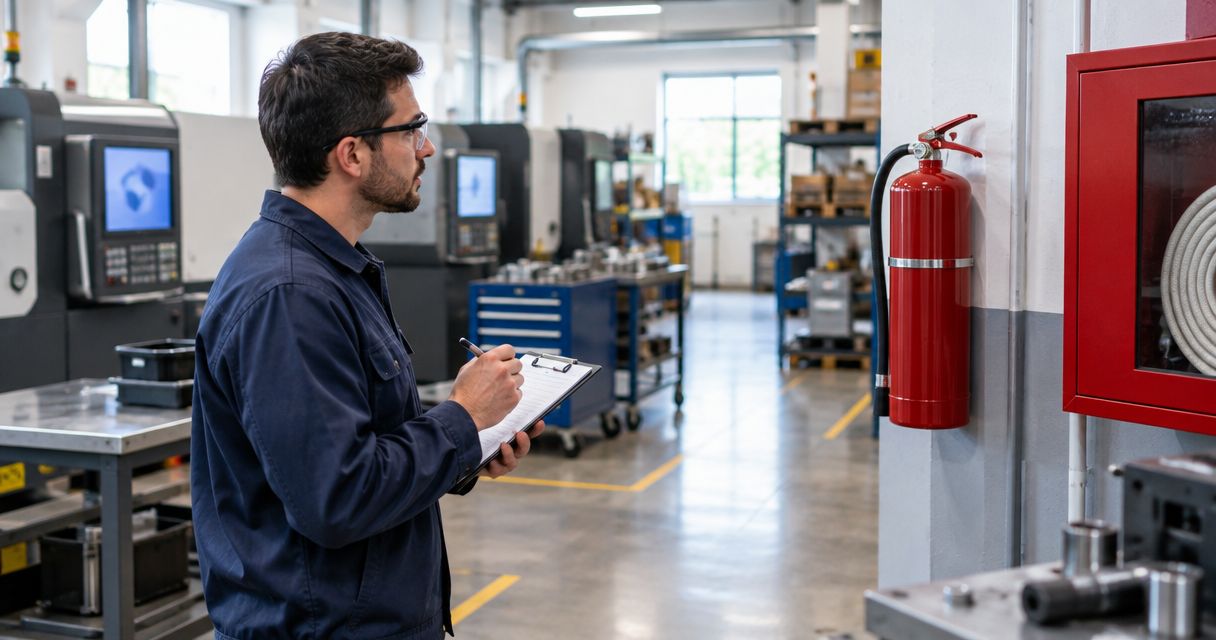
Your manufacturing fire prevention checklist should cover ignition sources, combustible storage, flammable liquids, hot work, electrical conditions, extinguishers, and escape routes. For a 2026 floor check, look at the work as it actually happens, then assign each finding to someone who can fix it and verify the correction. A completed checklist does not replace the controls, training, or plans your operation requires.
- A manufacturing fire prevention checklist must connect ignition sources, combustible materials, corrective actions, and proof.
- Check hot work, flammable liquids, electrical conditions, extinguishers, and exit routes against the actual work.
- OSHA requires monthly visual extinguisher inspections where its portable extinguisher inspection requirements apply.
- GigLine Safety & Compliance serves Piedmont Triad manufacturers that need on-site OSHA safety walkthroughs.
GigLine Safety & Compliance serves Piedmont Triad manufacturers that need on-site OSHA safety walkthroughs. Start with what is happening on your floor, not with a generic list of boxes to mark.
Fire prevention: What should you check on a small manufacturing floor?
Use this 2026 checklist to identify conditions that need attention. The right-hand column gives you something concrete to verify, not a substitute for evaluating the applicable standard.
| Check area | Look for on the floor | What to verify |
|---|---|---|
| Ignition sources | Welding, grinding, heaters, hot surfaces, and smoking near combustible materials | Ignition controls match the work and surrounding materials |
| Combustible storage | Cardboard, packaging, oily waste, and accumulated dust | Storage and housekeeping controls prevent hazardous accumulation |
| Flammable liquids | Open containers, transfer points, spills, and incompatible storage | Containers, handling, and storage meet applicable requirements |
| Hot work | Sparks reaching nearby materials, openings, or adjacent spaces | Authorization, protection, and fire-watch arrangements match the job |
| Electrical conditions | Damaged cords, exposed wiring, overloaded equipment, and obstructed working space | Unsafe conditions reach qualified personnel for correction |
| Extinguishers | Blocked access, damaged equipment, or unresolved inspection findings | Suitable equipment is accessible, inspected, and maintained |
| Escape routes | Storage in passageways, obstructed doors, and confusing routes | Employees can reach an exit without passing through blocked space |
| Employee response | Unclear alarm, evacuation, or extinguisher-use instructions | Employees know their assigned response and its limits |
Check the task and the surrounding area together. A grinder, container, or stack of cartons tells you little by itself. The problem is often the relationship between them.
1. Find where heat and fuel meet
Start at the workstations. Look at welding, cutting, grinding, heating, and other processes that produce heat or sparks. Then follow where those sparks, hot particles, or heated surfaces can reach.
Check behind equipment and below elevated work. Look at nearby packaging, waste containers, wall openings, and storage areas. Do not assume the visible work surface is the whole exposure.
OSHA's general-industry welding and cutting rule, 29 CFR 1910.252, addresses fire prevention around hot work. Its fire-watch conditions include appreciable combustible material within 35 feet of the operation and other conditions where sparks or heat can reach combustible material.
That distance is not permission to ignore materials farther away. The same rule addresses readily ignited combustibles beyond 35 feet and openings that expose adjacent or concealed spaces.
2. Check storage, waste, and dust
Walk the material route from receiving to production to waste collection. Look for packaging piled beside equipment, combustible scrap accumulating beneath workstations, and waste that has no assigned removal routine.
OSHA's fire prevention plan rule, 29 CFR 1910.39, requires procedures to control accumulations of flammable and combustible waste where that plan is required. A instruction to keep things tidy is not a workable procedure unless employees know what to remove and who handles it.
Treat combustible dust as a separate evaluation. Dust on overhead surfaces, inside equipment, or around collection systems needs attention beyond sweeping the visible floor. Do not assume every dust has the same fire or explosion properties.
Do not choose a cleanup method before you understand the material. Obtain the relevant material information and competent technical input. Blowing accumulated combustible dust into the air can create another hazard instead of correcting the first one.
3. Check flammable liquid handling
Look where employees actually open, pour, dispense, and use liquids. Storage matters, but so does the transfer operation. Check container condition, identification, nearby ignition sources, and how employees handle spills.
Use the safety data sheet to identify the material's hazards. Then evaluate the applicable storage and handling requirements under 29 CFR 1910.106. A container label alone does not establish that the storage arrangement is suitable.
Do not treat a flammable liquid cabinet as proof that every surrounding practice is correct. Check the materials, quantities, container types, and handling arrangement against the provisions that apply to your operation.
Employees also need usable spill instructions. They should know when to stop work, report the release, and keep people away rather than attempt a cleanup they are not equipped or trained to perform.
4. Check electrical conditions without opening equipment
For an ordinary floor walkthrough, keep electrical panels closed. Look for damaged cords, damaged enclosures, obstructed working space, and equipment used in ways that conflict with its listing or labeling.
Report signs of overheating or damage through your established procedure. Do not ask an unqualified employee to remove covers or investigate energized parts. OSHA's electrical work-practice requirements distinguish qualified-person tasks from ordinary observation.
Electrical fire prevention is not a PPE shopping exercise. Equipment condition, installation, use, and safe work practices come first. The guide to arc-flash and electrical safety PPE for manufacturers addresses a related topic, but PPE does not correct damaged wiring or an unsafe installation.
5. Check extinguishers and employee instructions together
Where OSHA's portable extinguisher inspection requirements apply, 29 CFR 1910.157(e) requires a visual inspection monthly and a maintenance check annually. Check access and condition, not just whether an inspection record exists.
Look for blocked equipment, visible damage, and unresolved service findings. Verify that the selected extinguishers match the hazards. Selection and distribution depend on the anticipated fire classes and the size and degree of the hazard.
Then ask what employees are supposed to do. Where extinguishers are provided for employee use, OSHA requires an educational program on general extinguisher-use principles and the hazards of incipient-stage firefighting at initial employment and at least annually afterward.
An extinguisher on the wall is not an instruction to fight a fire. Employees need clear boundaries. Your emergency arrangements must address evacuation, alarms, and any designated employee responsibilities.
6. Walk the exit route from the workstation
Start where an employee works, not at the exit door. Follow the route through aisles, turns, doors, and intervening spaces. Look for storage, equipment, or temporary work that interrupts the path.
OSHA's exit-route maintenance requirements in 29 CFR 1910.37 prohibit placing materials or equipment, permanently or temporarily, within an exit route. Temporary staging is still staging in the route.
Check the route during normal production conditions. A clear aisle before deliveries arrive does not tell you whether the route stays clear during the shift. Include shutdown work and contractor activity when those operations change access.
Why this matters on a small manufacturing floor
Fire prevention is not confined to one department. Production creates heat. Receiving brings packaging. Maintenance changes equipment. Contractors bring different tasks into the same space.
Your 2026 check needs to connect those activities. A condition that looks acceptable during ordinary production can become unsafe when someone starts welding beside stored material or blocks a passage with shutdown equipment.
Keep the distinction between a requirement and a shop rule clear:
- Requirement: An applicable OSHA provision establishes what the employer must do.
- Guidance: A recommended practice helps you evaluate or control the hazard.
- Employer policy: Your shop sets an operating rule, such as its authorization procedure for hot work.
A stricter shop rule can be useful. Label it honestly rather than presenting every local instruction as an OSHA requirement.
Why the manufacturing fire prevention checklist varies
Use the same core checks, but adjust their depth to the work. These factors change what you need to examine:
- Materials: Flammable liquids, ordinary combustibles, and combustible dust present different hazards.
- Processes: Welding, grinding, heating, and liquid transfer need task-specific controls.
- Layout: Openings, adjacent spaces, storage locations, and exit routes affect exposure.
- Employee assignments: Evacuation-only arrangements differ from arrangements involving designated extinguisher users.
- Operating changes: Maintenance, shutdowns, and contractor work change the conditions on the floor.
- Applicable standards: Written plans and specific controls depend on the requirements triggered by your operation.
Do not add a control merely because another shop uses it. Identify the hazard and applicable requirement first. Then choose a correction that addresses both.
Should employees evacuate or use an extinguisher?
Decide that before an emergency. For your 2026 review, compare your written instructions with employee assignments and the requirements that apply to your extinguisher arrangement.
| Response arrangement | Best suited to | Benefit | Limitation to address |
|---|---|---|---|
| Evacuation-only policy | Employers directing employees to leave rather than fight fires | Gives employees a clear response boundary | Must satisfy the conditions of any applicable extinguisher exemption |
| Designated extinguisher users | Employers assigning specific employees to use firefighting equipment | Makes the assignment explicit | Designated employees require appropriate training |
| Extinguishers provided for employee use | Employers permitting employee use under defined instructions | Provides equipment for the assigned response | Requires education and clear limits, not an assumption that everyone should act |
These are operating arrangements, not interchangeable shortcuts. OSHA's 29 CFR 1910.157 contains specific application provisions and exemptions. Do not remove equipment or change employee assignments without evaluating those provisions and other applicable fire-code requirements.
Does a small shop need a written fire prevention plan?
An employer with 10 or fewer employees can communicate a required fire prevention plan orally under 29 CFR 1910.39. That exception concerns the written format. It does not eliminate the plan's required content or employee information.
The fire prevention plan rule applies when another OSHA standard requires the plan. Check applicability before declaring that every small manufacturer needs the same document.
How long must a hot-work fire watch stay afterward?
At least 30 minutes after welding or cutting ends is required under 29 CFR 1910.252 when the fire-watch requirement applies. The purpose is to detect and extinguish possible smoldering fires. Determine the need for a watch from the job conditions, including exposed combustible materials and adjacent spaces.
Turn a finding into a verified correction
Keep the process plain: FIND, BUILD, MAINTAIN. Find the condition. Build the correction. Maintain the control so the same problem does not return.
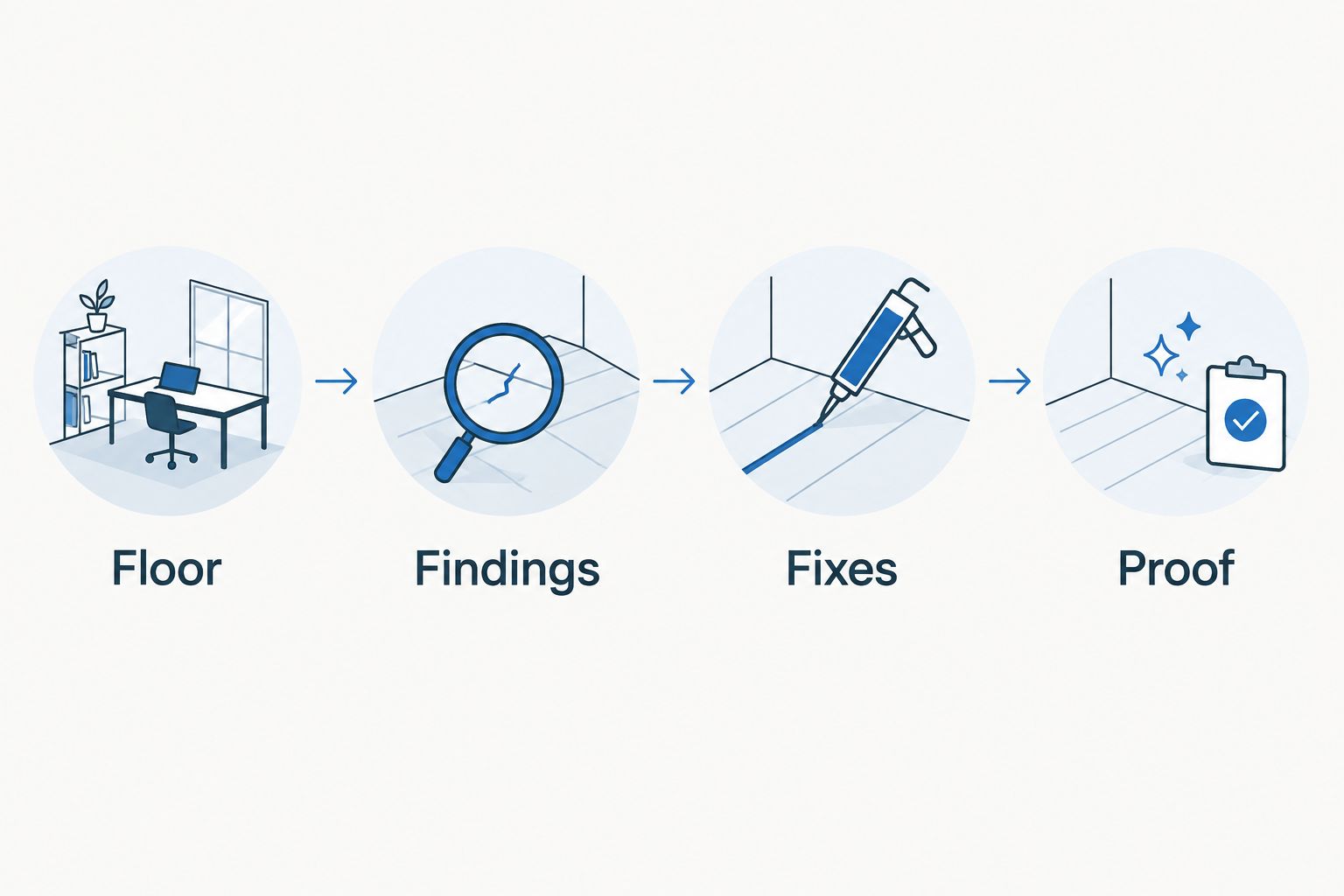
Use four entries for each finding:
- Floor: Record the location and the task being performed.
- Findings: Describe the condition and the hazard it creates.
- Fixes: Assign the correction, a responsible person, and a completion date.
- Proof: Verify the correction where the work happens and retain supporting evidence.
A photograph can show that stored material was removed. It cannot, by itself, prove that employees understand a new procedure. Match the evidence to the correction: observation for physical conditions, suitable records for maintenance, and appropriate verification for training.
For Piedmont Triad manufacturers, requesting a Compliance Readiness Visit from GigLine Safety & Compliance is a relevant next step when floor conditions and documentation need attention. A visit is not a guarantee of compliance. Keep responsibility for corrective action and ongoing controls clear.
Request a Compliance Readiness Visit
Start with the floor conditions and documentation that need attention.
FAQ
What should a manufacturing fire prevention checklist include?
A manufacturing fire prevention checklist should include ignition sources, combustible storage, flammable liquids, hot work, electrical conditions, extinguishers, exit routes, and employee response. Record the correction and verify it, rather than stopping at a checked box.
How often should we visually inspect fire extinguishers?
OSHA requires monthly visual inspections where the portable extinguisher inspection requirements in 29 CFR 1910.157 apply. The same section requires an annual maintenance check.
Does having fewer than 10 employees eliminate the fire prevention plan requirement?
No. Under 29 CFR 1910.39, employers with 10 or fewer employees can communicate a required fire prevention plan orally. The exception does not remove the required content.
Is keeping combustibles 35 feet from welding enough?
No. OSHA's welding and cutting rule also addresses sparks reaching readily ignited material farther away and openings exposing adjacent or concealed spaces. Evaluate the whole job before authorizing hot work.
Can every employee use an extinguisher during a fire?
Do not assume every employee is assigned to use an extinguisher. Define evacuation and extinguisher-use responsibilities, then provide the education or training required for those arrangements.
Should I open electrical panels during a fire prevention walkthrough?
Do not open electrical panels as part of an unqualified visual walkthrough. Report damage, overheating indicators, or other concerns for evaluation through your established electrical safety procedure.
Can GigLine Safety & Compliance guarantee that my shop will pass an inspection?
A safety walkthrough is not a guarantee of an inspection outcome or compliance. GigLine Safety & Compliance provides on-site OSHA safety walkthroughs for manufacturers in the Piedmont Triad region.
Before you close the checklist
Repeat the check when the work changes. A clean production floor does not prove that tomorrow's maintenance task is controlled. Look again when welding starts, storage moves, or contractor work changes the route out.
For your 2026 review, use OSHA's general-industry provisions as the requirement references: 29 CFR 1910.38 and 1910.39 for applicable plans, 1910.37 for exit-route maintenance, 1910.106 for flammable liquids, 1910.157 for extinguishers, and 1910.252 for welding and cutting. North Carolina employers should also confirm applicable NC OSH requirements.
Close the finding only when the correction works on the floor. A completion date proves that someone entered a date. It does not prove that the hazard is controlled.